Exploring Hamilton by Bike

It’s been a while since I have made a blog post, but I had such an amazing day today, I want to write about it to cement the memory.

The day started cool and misty with a walk with Owen and Bailey. It was a perfect autumn day with a few of the leaves changing colour.

The boys all have the day off school today, which I forgot, when I planned to spend the day cycling in Hamilton with my friend Rani, before picking up Megan for Thanksgiving and Reading Week.

They don’t really mind when I leave them since it means they can do their own thing without me bugging them about spending too much time in front of screens.

Years ago, I used to spend a lot of time cleaning the house and resent it when Michael and the kids made messes.  Michael told me I should lower my standards since no one else cared how messy the house was.  Over the years I have managed to do so.  Apparently, I have been so successful that today, Alun, my 17 year old, vacuumed, dusted and washed the stairs and mopped the kitchen and hallway tiles because the mess was offending him.

I met Rani at Princess Point at 10am.  Here is a link to the route I planned. In June, another friend, Erica, and I spent the day cycling in Hamilton.  That day I planned for us to use the bike trough on the Kenilworth stairs to get our bikes up the mountain, but we missed Kenilworth by a few kilometres, looked at the map and decide to follow the Red Hill trail to Albion Falls, our destination.  It was a beautiful, but tough ride, on a dirt or crushed gravel path with steep hills up and down.  After leaving the falls we returned to the lower city on the Hamilton-Brantford rail trail. It was a lovely gradual decline through the trees along the face of the escarpment and I wanted to try riding up it, which is what we did today.

The mist was lifting just as I arrive at Princess Point where Rani had arrived and was taking pictures.  We unloaded our bikes and set off to discover that Rani, while trying to pump up her tires last night, pretty much completely emptied them.  Neither one of us had a pump so we loaded up the bikes and drove to the Bike Repair station on Locke St.  Unfortunately, the pump only had a Schrader end, not Presta, which is what Rani needed.  So we drove to Pierik’s Bike Shop, nearer to Princess Point than the Bike Repair station on Locke, where a friendly, helpful staff member pumped up Rani’s tires.  Back at Princess Point, we unloaded the bikes again and set off.

We cycled around the bay and then up James Street in search of an independent coffee shop. Last week I found a list of 15 in Hamilton and am determined to try them all.  I couldn’t think of a single one in Brampton.  Sigh.

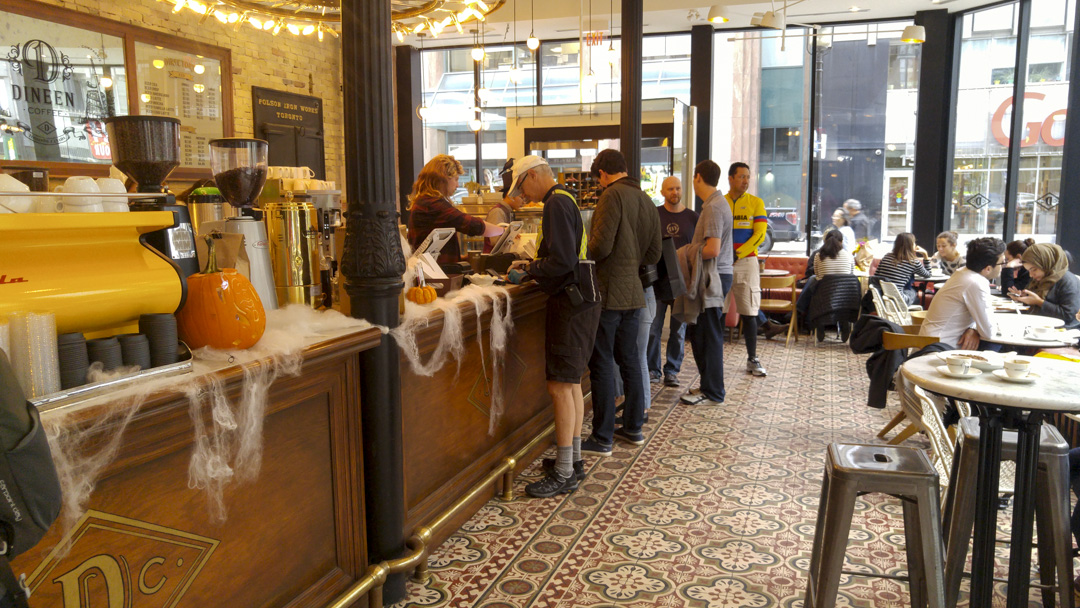
We stopped at the Mulberry Street Coffee House and had some awesome cappuccino and baked goods to fuel up. I’ve now been to three on the list of 15.

We continued on our way and we very pleasantly surprised at how easy it was to climb the mountain on the rail trail.  It was about 100 metres ascent over 8km.  Much easier than riding up any of the street accesses or the Red Hill Trail that Erica and I took.

We briefly used the great Cannon Street cycletrack which has little bicycle shaped insets in the lights for bikes.  We also came across this great new crossing on Limeridge Road East where there are no curbs and pedestrians have the right of way when they are present, but otherwise drivers do not need to stop here.

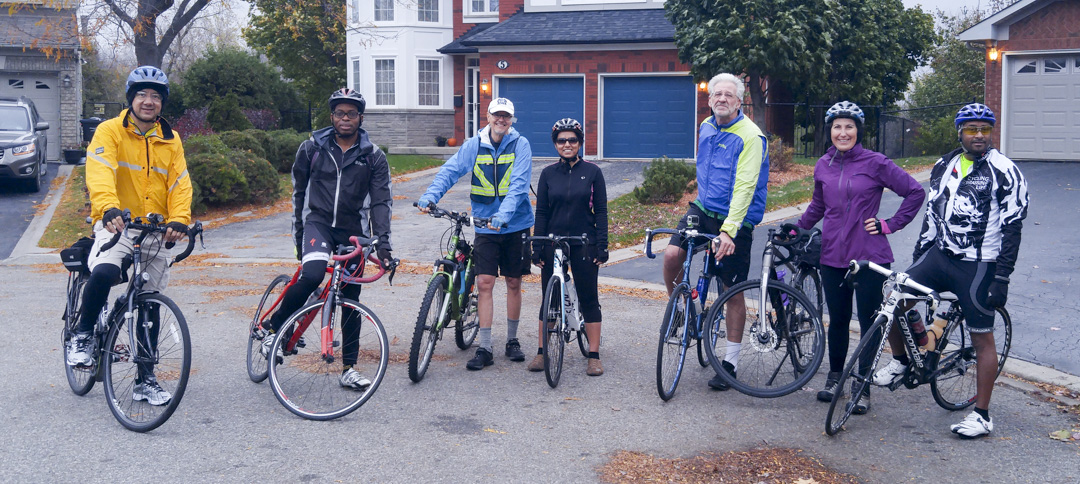
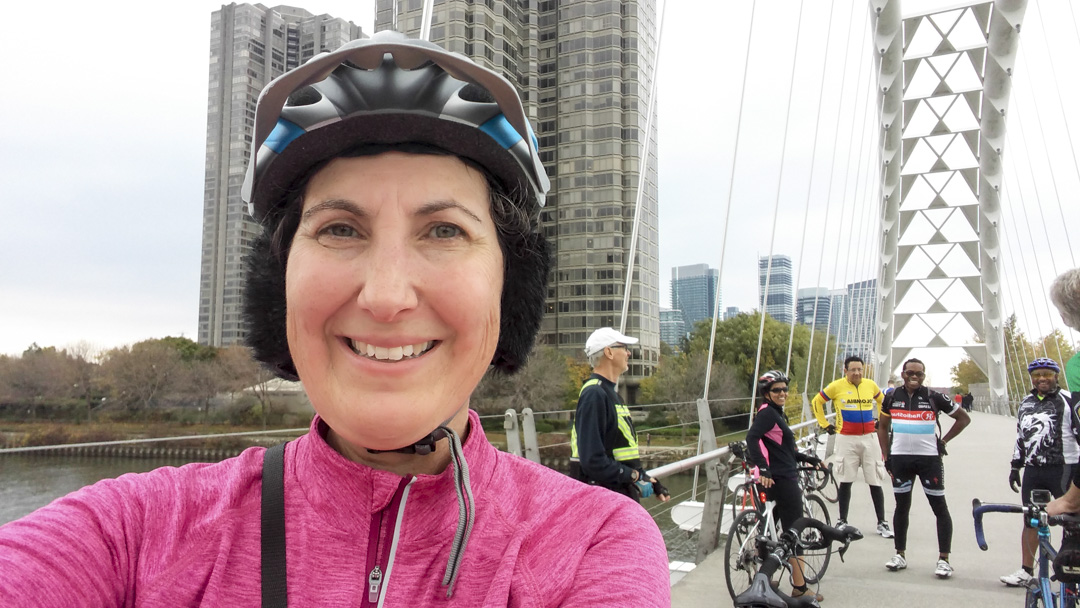
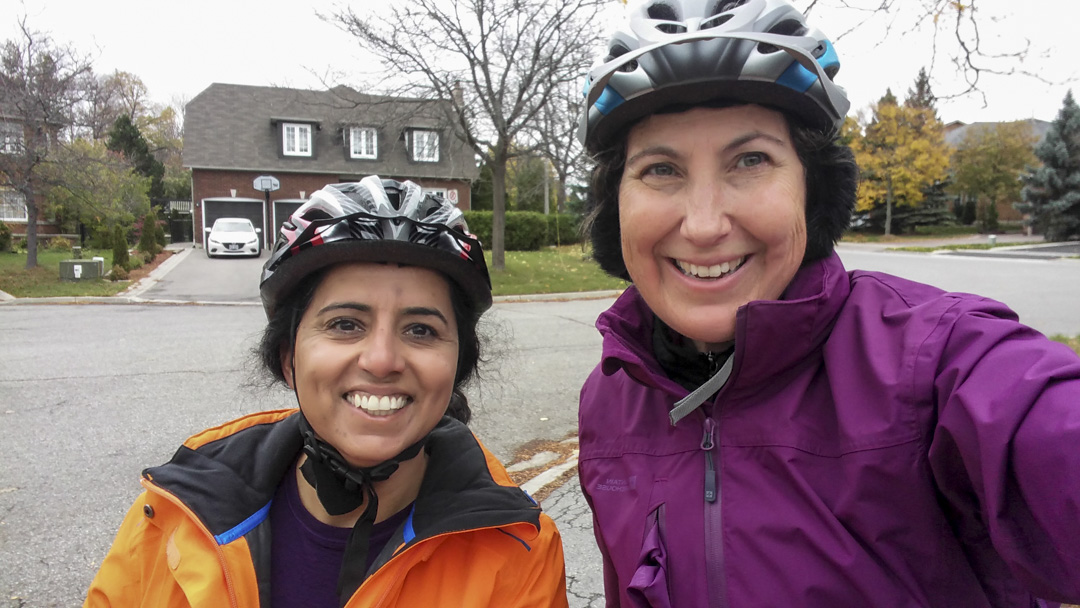
We’ve just finished the climb and Rani is still smiling.

img_20161007_124226-editsm

Here are a couple more pictures of the rail trail.  Much of it was covered by trees and so pleasant to cycle through, but I didn’t take any pictures in that part.

img_20161007_131044-editsm

Here we are at Albion Falls.  It was a bit difficult climbing down with the cleats on the bottom of my sandals.

We then cycled along Mountain Brow Boulevard, a street that went on a road diet and became a complete street a couple years ago.  It is residential on one side and a narrow linear park overlooking the lower city on the other.  It used to be a four lane cross section, but is now two, with some parking and a wonderful wide multi-use path.

The views were awesome.  When we couldn’t see over some low bushes Rani climbed up on this wall.  I soon followed.  My family, and my friend Patti, with whom I have been cycling and exploring since Grade 7, usually discourage this type of “risky” behavior.  It was fun having someone else lead the way.

Here’s the view from the top.

img_20161007_132233-editsm

Back in April, I did some cycling and exploring of the escarpment staircases which I wrote about here. I talked about Uli, who single-handedly build an escarpment staircase.  We met him tending it today.  What a modest fellow.

img_20161007_132929-editsm

We found a great place for lunch.

Then continued along to the Chedoke Radial Trail, which I hadn’t explored before.  What a wonderful ride down the mountain it provided. It started under an hydro tower and passed several waterfalls.  It is part of the Bruce Trail.

We looked down over the highway and crossed a bridge.


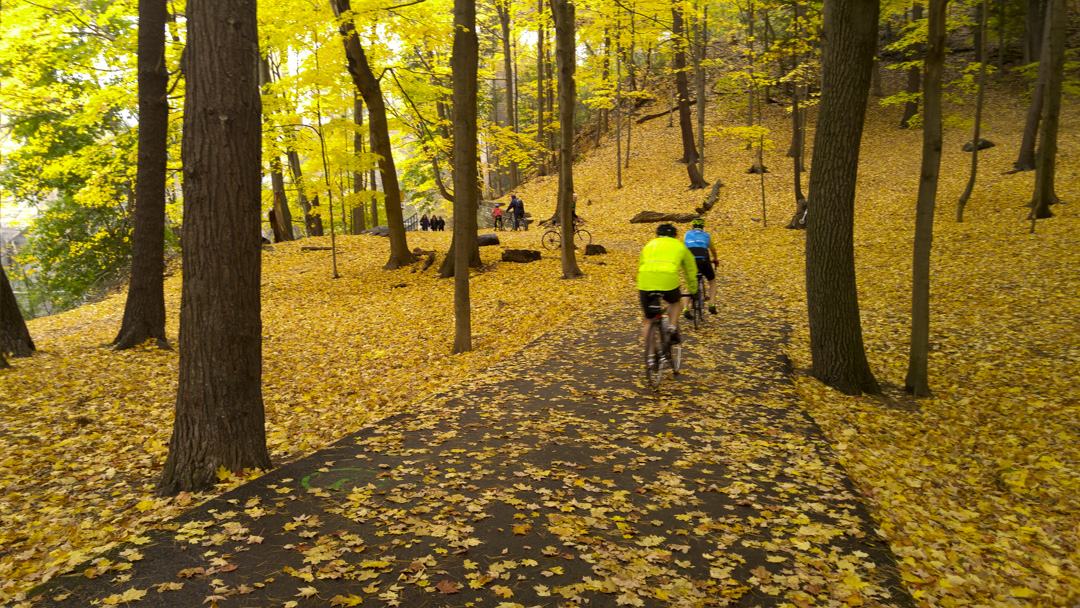
There was a lovely canopy of trees all the way down.

img_20161007_152137-editsm

By following the route clockwise we had gentle inclines going up and fun, steeper rides going down.

It was a perfect autumn day, enhanced by a lovely visit with my daughter on the way back home.

Morning mist banished by sunshine.
Autumn colours.
Cycling in a city that gets it.
New friend with the same passion.
It doesn’t get any better!


Peel School Board Bussing Policy

I have just written to my Peel Board Trustee, Chair and the Minister of Education about Peel’s bussing policy and am reproducing the letter here.

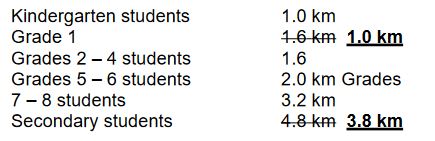
Eligibility for bussing is as follows and was recently revised downward.

Busing eligibilty

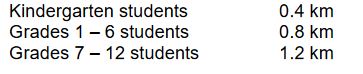
The distance a child must walk to the bus stop is even less.

Walk to bus stop

Trustee Singh, Chair McDougald and Minister Hunter,

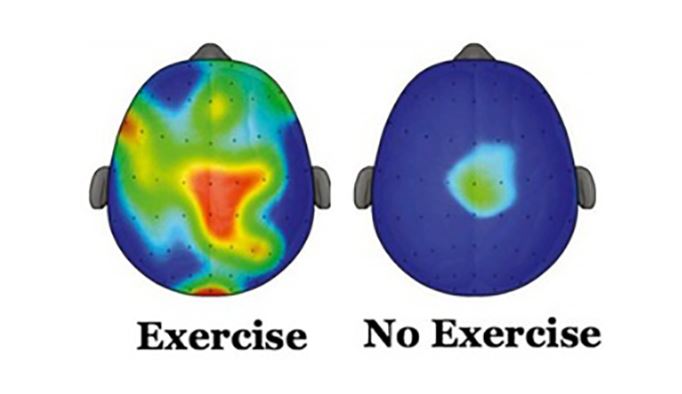
On the final day of Bike To School Week at Robert J. Lee Public School, the mother of a kindergarten student was locking his bike to the rack as I was counting the bikes. The bell had already rung.  She told me that they had been running late and she told her son they would drive the car to school.  “No Mum”, he told her, “I have to ride my bike and exercise my brain”. I was thrilled.  The message being given at RJ Lee is working and children, even very young ones, can influence their car dependent parents’ behavior.

Unfortunately, the Peel Board of Education, unlike this kindergarten student, does not recognize in its transportation policy,  the importance of building exercise into the lives of children, and continues to enact policies which lead to obesity, behavioral issues and lower test scores.

Brain on exercise

The Peel Board should be taking a leadership role in teaching the next generation that the habits of theirs parents have led to a health crisis, and congestion and injuries on our roads.  Teaching children healthy habits takes more than talking at them in classrooms, it takes leadership and modelling. It requires board wide encouragement of Active Transportation and minimizing the wholesale bussing of children.

The recent policy change to reduce eligibility distances for bussing is a travesty, and not only are the eligibility distances too short, the maximum distance a child must walk to a bus stop is at least as bad.  If children who are bused were required to walk up to the same minimum distance to their bus stop as children who do not receive bussing are required to walk to school, there would be benefits.

  • Children would get more exercise on the way to and from the bus stop
  • Fewer bus stops would be required leading to the potential for
    • Shorter travel times
    • Cost savings

My four children aged 12-19 have attended or are attending Peel Board schools.  They have walked to school, or when attending high school programs outside our catchment area, walked to and from public transit.

The first year my eldest attended middle school she qualified for bussing. She chose to ride the bus, not because the distance was too far for her to travel, but because the bus was available.  She rode it because her friends did.  This behavior occurred in a child who regularly walked much longer distances and was raised in family that engaged in, and promoted, active transportation. Such widespread availability of unnecessary motorized transportation for children is a serious disincentive to exercise.

I encourage you to read the Brampton Kids on Bikes report which makes very plain the destruction caused by a car dependent society.

I also encourage you to read about the success I have had, in partnership with Johnna Varriano, principal of Robert J Lee Public School, in encouraging cycling to school and reducing road congestion.

I encourage you to be leaders.  Leadership is leading people somewhere they wouldn’t otherwise go. Reducing bussing eligibility distances won’t be popular, but it is the right thing to do.  Do the right thing.  Re-visit this policy.

Bike To School Week – Year 2 – Robert J. Lee

On the final day of Bike To School Week, the mother of a kindergarten student was locking his bike to the rack as I was counting the bikes. The bell had already rung.  She told me that they had been running late and she told her son they would drive the car to school.  “No Mum”, he told her, “I have to ride my bike and exercise my brain”. I was thrilled.  The message is working and children, even very young ones, can influence their car dependent parents’ behavior.

For the second year in a row I worked with Walk+Roll Peel and the principal at my children’s school in northeast Brampton to encourage participation in Bike Week.  In 2015, it was due to my encouragement that the school decided to enroll.  You can read about that week here.  This year, the principal assigned a teacher to work on Bike To School Week and asked me to help.  I was pleased that, not only did they want to participate again, but that they also took the lead this time.

Bike To School sign 2016

The school has an enrollment of 770 students.  On our final day of the week we had a 17% cycling modal share! Bike Week was promoted to families in the school newsletter, advertised on the notice board outside the school before Bike Week began and added to the morning announcements at the school each day, during the week leading up to Bike  Week, and during Bike Week, with a student reading bike related tips.

Additionally, at the Character Assembly in the week prior to Bike Week, I gave a presentation on cycling to school, which you can see here.  This image, from the presentation, is what stuck in the kindergarten student’s mind.

Brain on exercise


The week was wildly successful with bike racks full to overflowing.

IMG_20160603_081949editsmall

We had to direct children to lock their bikes up again the kindergarten fence.

IMG_20160601_082615editsmall

We didn’t have enough stickers for the Bike To School Week counting chart.

IMG_20160603_082813editsmall

Prior to running Bike Week for the first time there were about 10-15 cyclists daily.  Up to 77 students cycled during the first Bike Week, with 50-60 students cycling daily during the rest of the month.

Bike Week bar graph
Bike Week Year 2 saw 90-130 students cycle each day, with 75-85 students cycling daily in the weeks since.
I will end with a conversation I had last week with the teacher who has for years directed traffic in the Kiss ‘n Ride as her morning duty. Last week she gestured to a driveway that had only a few cars and no line of cars on the street waiting to turn into the school causing a traffic jam.  She told me, “My job has gone from being the hardest one to the easiest one”.

I advocate to make Brampton a better place for cycling for everyone and to change the behavior of the next generation.  It’s working.


Dixie Road Cycling Facilities South of Clark Boulevard

This is the second of three blog posts I will make about cycling in, or near, the Dixie Road corridor, and the various cycling facilities, or lack thereof.

  1. Dixie Road Cycling Facilities North of Bovaird Drive
  2. Bramalea GO Station to Clark Boulevard (Bramalea City Centre) along Dixie Road
  3. Clark Boulevard to Bovaird (Chinguacousy Trail)

Dixie Road is a regional road.  The planning and construction is done by Peel Region, rather than by the City of Brampton.  Brampton is responsible for maintenance once construction is complete, for both the road and the sidewalks and multi-use paths.

The Region of Peel is currently engaged in widening Dixie Road to three lanes in each direction.  At the same time they are replacing the sidewalk on the west side, from Clark Boulevard to 400 metres north of Steeles.

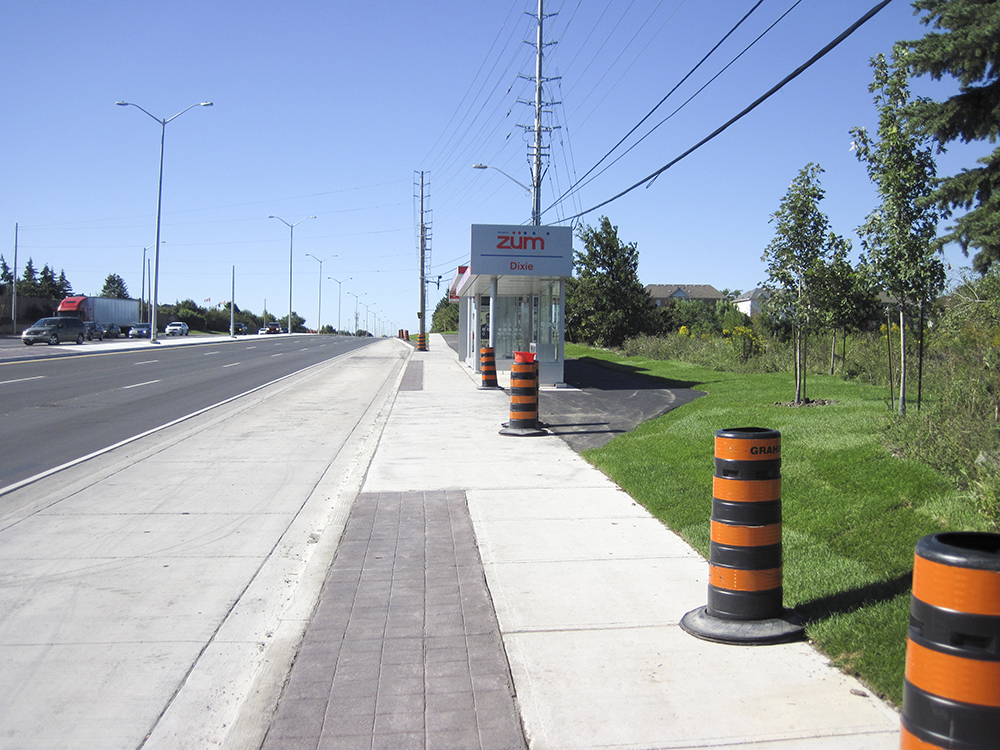
The intersections where Dixie Road crosses Steeles Avenue and Bovaird Drive were reconstructed prior to a general road widening to allow for Brampton Transit’s Zum buses to travel in a reserved queue jump lane through intersections. At that time no multi-use path was installed .

I had a conversation with staff at the Region of Peel about the pointlessness of infrastructure that just ends 400 metres north of a major intersection, especially on a road with the volumes of car and especially, truck traffic, that is carried on Dixie.  They agreed to look into the feasibility of continuing the path south to Steeles while construction crews were still on site and I am pleased to report that I have been told that is exactly what will happen.

Victory for advocacy. Thanks to Regional staff for listening and acting.

In April, I attended my first Ontario Bike Summit, courtesy of the City of Brampton.  It was educational to hear what other cities are doing.  One item that was of particular interest to me was that Metrolinx provided funding for the Spur Line trail in Waterloo in order to improve Active Transportation infrastructure leading to GO and Via Trains.

In a board meeting presentation last year Metrolinx explained:

  • Designs for station facilities will be guided by both the way travel modes are used today and policies intended reduce dependency on single-occupancy vehicles and towards more sustainable modes.
  • While investments will be made across all travel modes, those needed to achieve the shift towards more sustainable modes will be prioritized.

Currently only 1% of riders cycle to GO rail service and I suspect the percentage that cycle to Bramalea GO Station is far lower than that, despite the fact that they have covered bike parking at both the north and south lots. Metrolinx states that, “Incentives to encourage and significantly increase cycling are needed (e.g. improved cycling routes and environment, secure bike parking, bike share, etc.)”.

Watching the Region improve cycling infrastructure along Dixie Road, hearing about Waterloo receiving $1.2M for their Spur Line Trail and knowing the proximity of of Bramalea GO station to the Dixie multi-use trail and one of Brampton’s few legal on-street bike lanes (Birchbank Road) led me to explore how all these elements could be connected. I hope that by writing this blog I can inspire the City of Brampton, the Region of Peel and Metrolinx to work together to create an active transportation connection to Bramalea GO, a station on a very busy road in the middle of industrial lands, but not too far from some residential areas and existing AT infrastructure.

Let’s explore Dixie Road moving south from Clark Boulevard.

IMG_20160421_090615editsmall

Here, the sidewalk has been preserved and a multi-use path added between the curb and sidewalk.  The pole in the foreground is a temporary one, but it is not clear whether or not the multi-use path will continue north to Clark.

IMG_20160421_090517editsmall

Continuing south, you can see the sidewalk has been removed and a wide multi-use path installed from curb to property line.

IMG_20160421_090359editsmall

I prefer the treatment in this section where the “salt strip” or snow storage area is constructed of a different material. I have not been able to get an answer as to why this is done is some places but not others, even along the same path, although it does tend to be at intersections, but sometimes extends quite far from the intersection.

IMG_20160421_090253editsmall

As you can see this section does not use pressed concrete for the salt strip, but expects users to somehow magically understand that the metre adjacent to the curb is not considered part of the multi-use path. In this picture I am standing at the northern end of the Rogers campus at the entrance to the south end of the Esker Lake Trail which is shown in the next image.

IMG_20160421_090250editsmall

This is a nice connection here, and the Esker Lake trail will be getting Brampton’s first Active Transportation-only crossing of Highway 410, when the Franceschini Bridge, between Williams Parkway and Bovaird, which used to be used to access a gravel quarry, is opened later this year.  Unfortunately, the Esker Lake trail leaves much to be desired, but I will address that in another post.

IMG_20160421_090055editsmall

This section differentiates salt strip and path.

IMG_20160421_085928editsmall

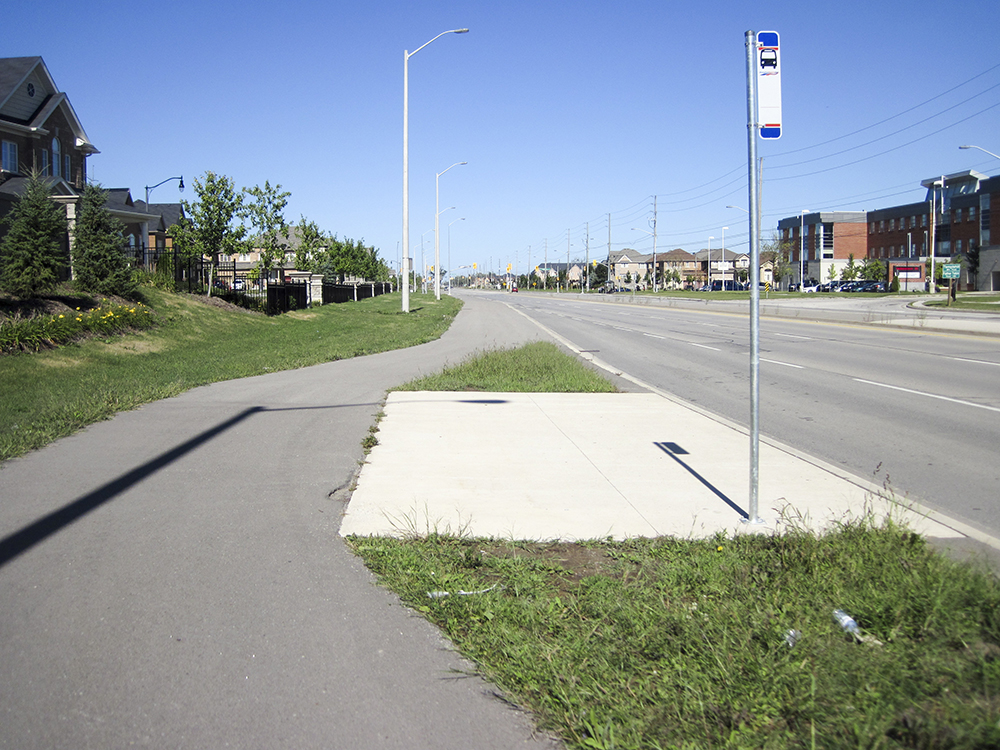
I am not sure how this bus stop will be handled.  In the first picture in this blog, you can see that a concrete bus pad was laid on which a shelter could be erected. Something else to note is that about 100 metres south of here is a Tim Hortons/Wendy’s. I hope that signage is installed to indicate that drivers should expect cyclists and not to stop on the path.  When I approached from the south, a driver was stopped on the path and looking north for a gap to turn right into, with never a glance to the south to see if anyone on the path was approaching.  Had I not stopped and waited I am fairly certain I would have been in front of him and crashed into when he turned.  This will be a common occurrence here, as drivers will not be permitted to turn left, and will therefore not look to their right before pulling out.

IMG_20160421_085742editsmall

This image is looking back north towards Orenda Road on the left and Birchbank Road on the right.  There is a legal bike lane on Birchbank.

IMG_20160421_085714editsmall

Continuing south from Orenda toward the Chrysler dealership.

IMG_20160421_083202editsmall

The road was widened enough under the rail bridge for the path to continue and it dips less than the road making it easier to traverse.  A sign should be installed where the material changes to concrete and the width narrows to indicate bikes welcome, but caution needed.  I saw this sign on Castlemore Road.

Narrow Single Lane

IMG_20160421_083259editsmall

As one emerges from underneath the bridge the path comes to an end about 400 metres north of Steeles.

IMG_20160421_083434editsmall

This is where, I have been told by Regional staff, they have determined that it is feasible to extend the path to Steeles Avenue.

Now let’s address getting to Bramalea GO Station.

Map around Bramalea GO crop

The red line on the map shows the trail gap which the region needs to complete to Steeles.

The blue line shows the route to the south lot bike parking at Bramalea GO. This route is 2km from the Steeles/Dixie intersection (north route).

The green line shows the route to the north lot bike parking at Bramalea GO and runs along Steeles. It is 1.2km from the Steeles/Dixie intersection (south route).

IMG_20160421_083545editsmall

Steeles and Dixie is a very large intersection, with six through lanes of traffic on each road plus left and right turn lanes.

So, there are two options for getting to the GO station. While the route to the north lot along Steeles is shorter, it requires a trip up and over the rail bridge, which which be challenging for some cyclists. The space available for a multi-use path is also more constrained, particularly over the crest of the bridge.  I didn’t take pictures along here, but when I go back to check out the 400m gap north of Steeles I will do so and provide an update.

My preference, and the one I have pictured below, is the route to the south lot via Dixie,  Advance and Alfred Kuehne, which, while longer, is flat and once off Dixie, the road allowances are wide and traffic relatively light.

IMG_20160421_083846editsmall

This is looking north from Advance Boulevard.  If the sidewalk were removed as it has been north of Steeles, a multi-use path could be installed.

IMG_20160421_084023editsmall

In this image I am facing east looking across Dixie at Advance.

IMG_20160421_084154editsmall

On Advance there is a sidewalk  on the north side of the road and nothing on the south.  By observing where the fire hydrant is you can see there is plenty of room for a multi-use path adjacent to the road.  The other possibility here is a bike lane if the curb-to-curb allowance would accommodate it.

IMG_20160421_084359editsmall

Alfred Kuehne also has a sidewalk  on the north side of the road and nothing on the south, with plenty of room for a multi-use path adjacent to the road.

IMG_20160421_084452editsmall

This is the only potential pinch point, but the bridge rails are probably high enough to allow bikes to travel over the sidewalk here with a warning to yield to pedestrians.  If not, they could be replaced.

IMG_20160421_084529editsmall

The driveway to the south GO parking lot is wide and could probably accommodate a bike lane.

IMG_20160421_084800editsmall

And, there is already a nice covered bike shelter awaiting cyclists.

The City of Brampton is currently undertaking an exercise to create an Active Transportation Master Plan and will not want to make any significant investments in the 18 months it will take to complete.  However, I would argue that this is a project that could be undertaken in the meantime and that by partnering with Peel Region and Metrolinx the cost could be shared and manageable.


The Dross Walk

Last week I wrote that I drove to Mississauga to attend Stephen Caulfield’s Dross Walk, but that I got the date wrong so did my own little Jane’s Walk around the Absolute Towers and Cooksville Creek.

Today was the Brampton Cycling Advisory Committee’s first community bike ride and the day dawned cold and wet.  We had many fewer attendees than actually registered, but I really can’t blame them – I would have stayed home had I not been volunteering to sweep the 15km ride.  We still had 16 people come out to brave the elements and enjoy ice cream afterward.  Do sign up for our future rides – there are nine more – I am sure the weather can only improve.

If you haven’t read the description of the Dross Walk you really must follow the link and read it all, it is very entertaining.  Here is a small excerpt.

“Walk the Dross. We’ll be thinking about the future and how this aesthetic nightmare would make a great set for a zombie movie (or home for actual zombies). This is not for babies or wusses. Please visit Malton before Dross Walk in order to build skills required for coping with hallucinatory landscapes.”

As we drove down the 410 it was overcast with sleet and gusty winds: perfect for the Dross Walk.  I realized I had forgotten my umbrella.  Oh well, too late.

We arrived a few minutes before the appointed time and spotted Stephen standing “in front of the shut down Goodwill in the plaza beside the payday lender”. We were a few minutes early so I ran over to McDonalds for coffee to brace myself for the promised headache.

Coffee in hand, we set off, down a set of crooked stairs, our first stop under a sign for Gardin bicycles, to hear about Joe Gardin who had the Italian passion for cycling, and set up part of his factory in Mississauga for bicycle manufacturing.

Across the street was Metal Works (not pictured), a recording studio owned by a member of Triumph and Mississauga’s downtown peeking over this industrial wasteland.

IMG_20160515_151952editsmall

We stopped to talk by this sign.

IMG_20160515_152001editsmall

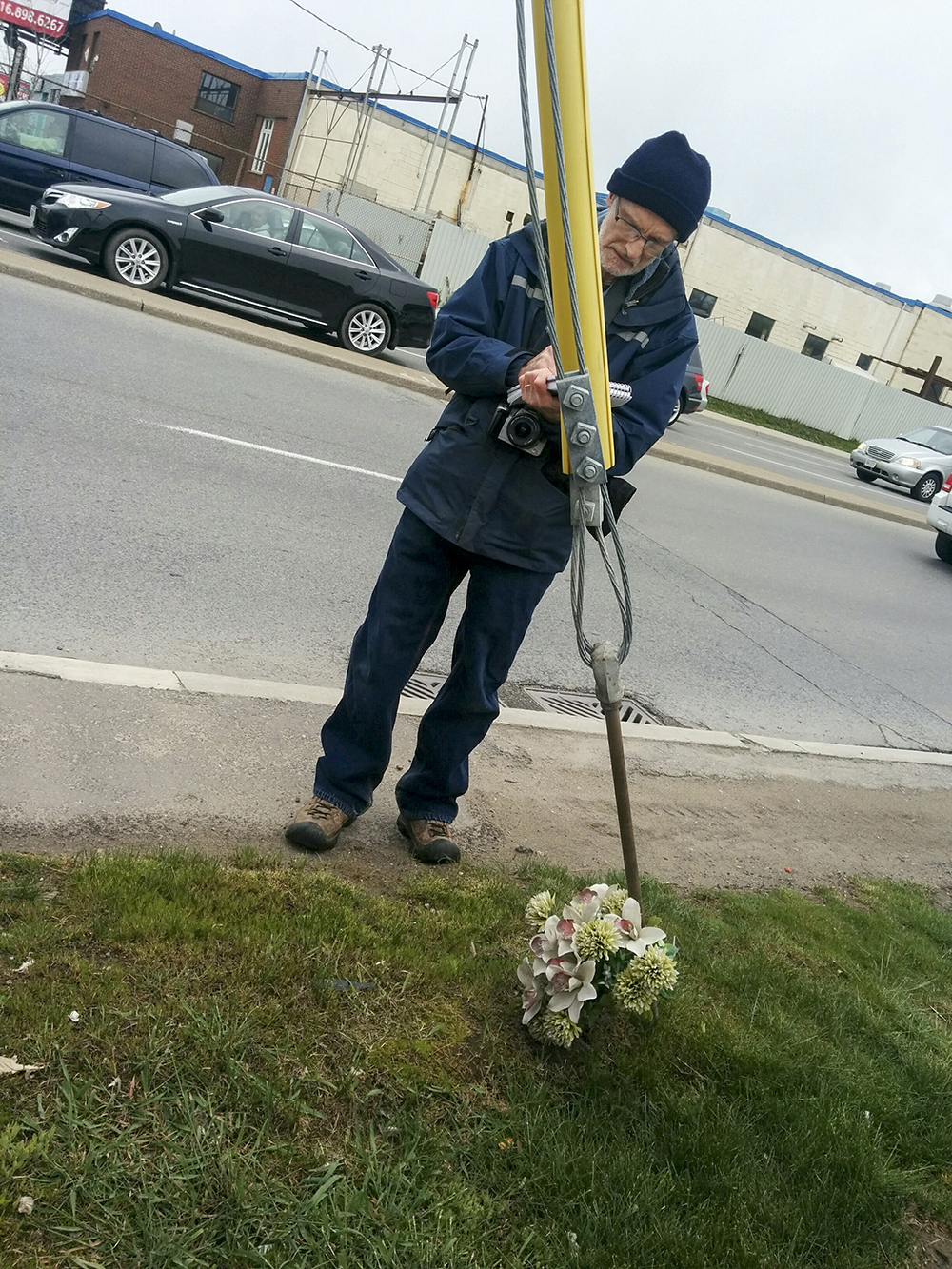
At Central Parkway and Mavis Road we found this small plastic bouquet of flowers, a reminder of how dangerous Mississauga’s streets can be for cyclists.  Despite having a Cycling Advisory Committee for ten years, in places like this, nothing changes much for cyclists.  A female cyclist was killed here in 2007 and an elderly male cyclist killed in the same spot in 2014.  A ghost bike placed here by Advocacy for Respect for Cyclists in September 2015 has been removed by the city.

IMG_20160515_152431editsmall


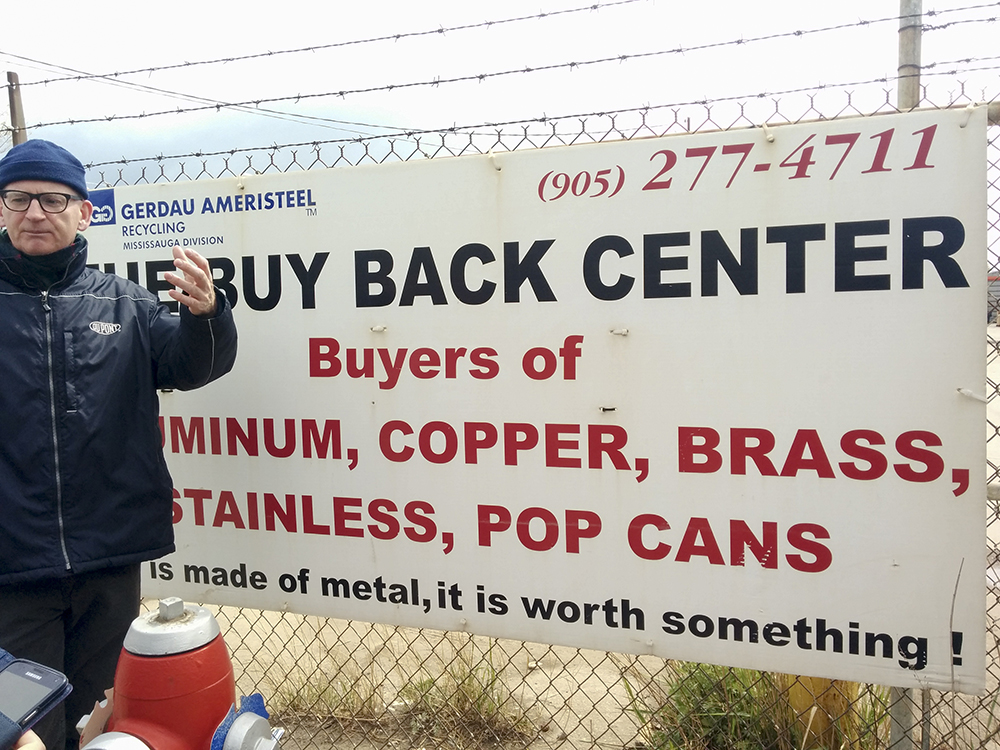
Here, Stephen tells us, is a business that buys scrap metal from the garbage scavengers that we often see after garbage is put at the curb, before the region comes to pick it up.

IMG_20160515_153643editsmall

Next we saw the site of the Mississauga train derailment on November 10, 1979, which led to the largest peacetime evacuation in North America, with over 200,000 people evacuated. That record stood until the New Orleans evacuation following Hurricane Katrina.  The train was carrying explosive and poisonous chemicals.  I lived in Mississauga a few kilometres from the explosion and we decamped to my aunt’s home in Peel Village in Brampton.  I have fond memories of missing school, going shopping, bowling and to the movies.  The accident could have been much worse, explained, Stephen, if not for the brave actions of the train’s brakeman, Larry Krupa, which allowed the un-derailed part of the train to be moved away from danger, preventing those cars from becoming involved in the fire. The city was re-opened on November 16. Stephen, who works at a car dealership adjacent to the tracks recently unearthed a piece of track and a railway spike from the explosion.

The mascot for the walk was the kildeer and it was like a treasure hunt finding the photocopies he had posted along the walk.  We also encountered two real kildeers in the Rogers Cable parking lot.

Having finished my coffee I began looking for a garbage can, but had to walk more than a kilometre before finding one in front of a Canadian Tire at Mavis and Dundas.  Despite the unpleasant landscape and many coffee cups blowing around I couldn’t bring myself to drop mine.

At Dundas Street we found the edge of Lake Iroquois, a prehistoric, proglacial lake that existed at the end of the last ice age 13,ooo years ago.  It was an enlargement of Lake Ontario that formed due to an ice sheet blocking the St. Lawrence River which caused water levels to be about 30m higher than present day.  Casa Loma sits on the Lake Iroquois shoreline as do the Scarborough Bluffs.

IMG_20160515_161853editsmall

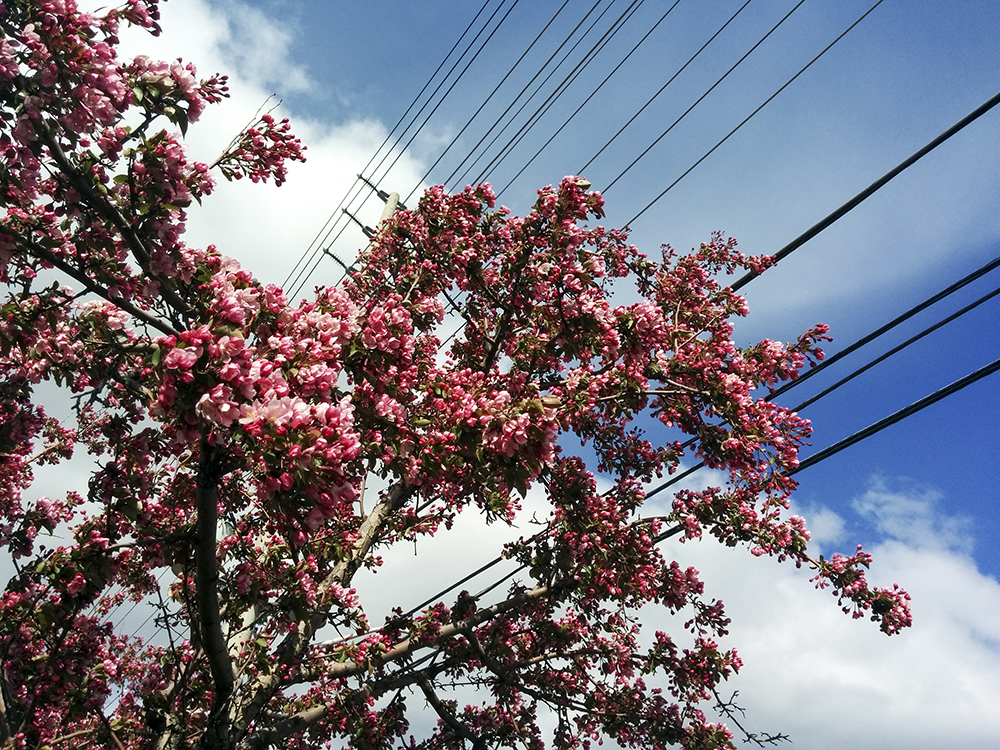
There was some beauty in the Dross Land – crabapple trees were in blossom, but the view was blighted by wires.

IMG_20160515_161913editsmall

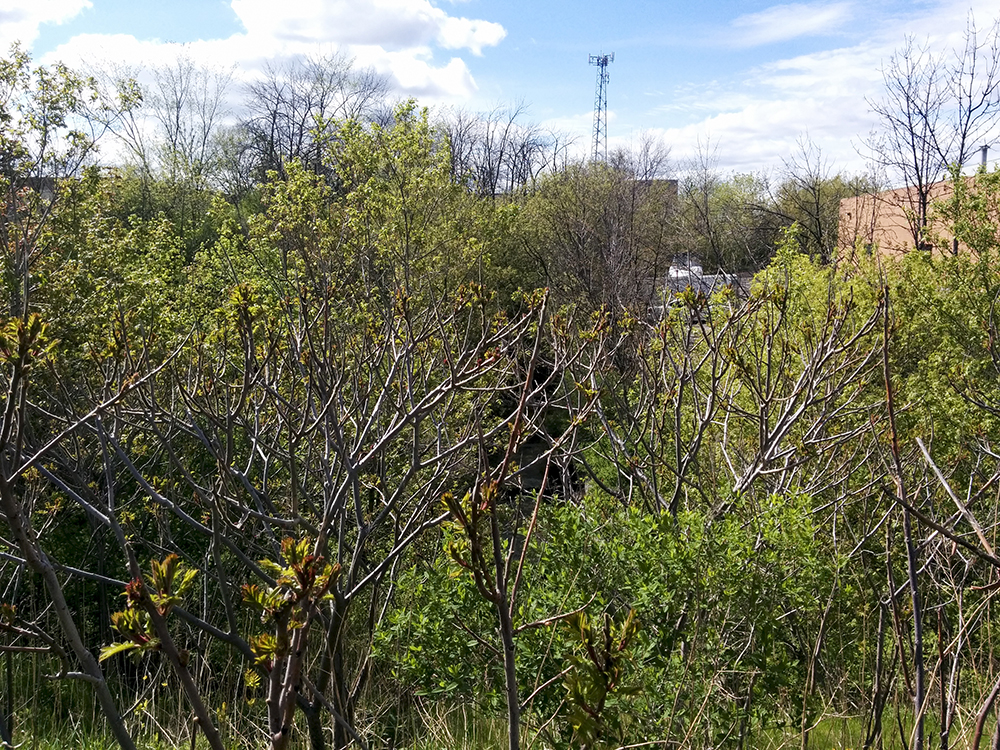
If you look closely through the brush you can see Wolfedale Creek, tamed by concrete and polluted by nearby industries.

IMG_20160515_162035editsmall

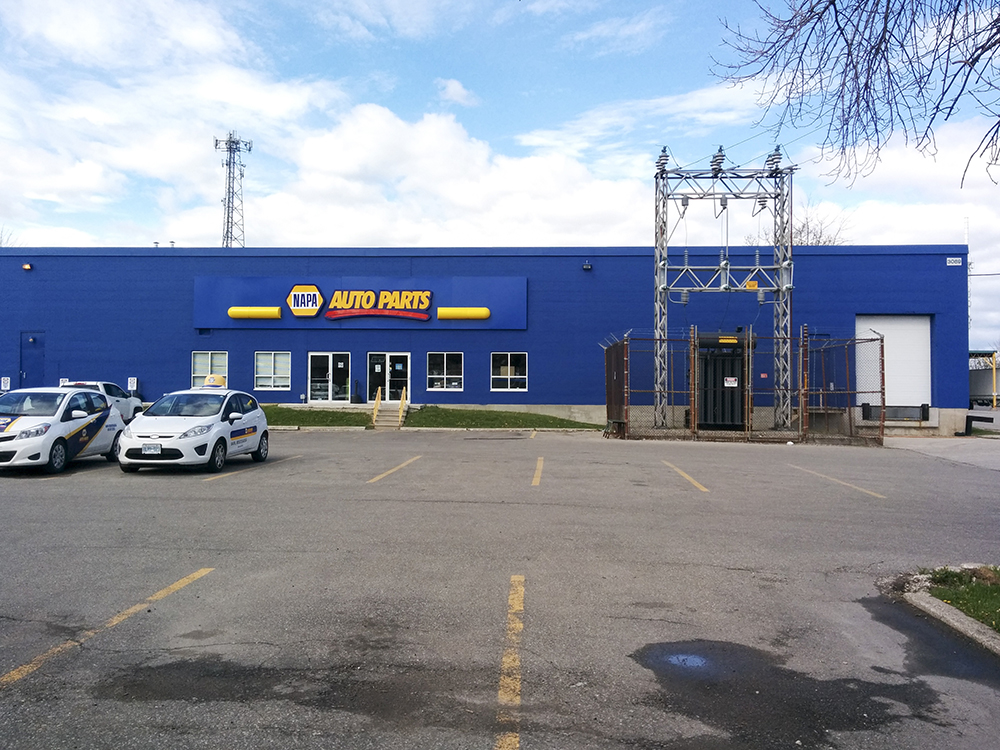
Many properties where there used to be manufacturing are now warehouses or service industries.

IMG_20160515_163107editsmall

We saw an ash tree completely stripped of its bark, having been infected by the emerald ash borer.  Earlier in the walk we saw a city works yard full of mulched ash trees with more arriving daily according to Stephen.  “It’s like an urban logging operation”.

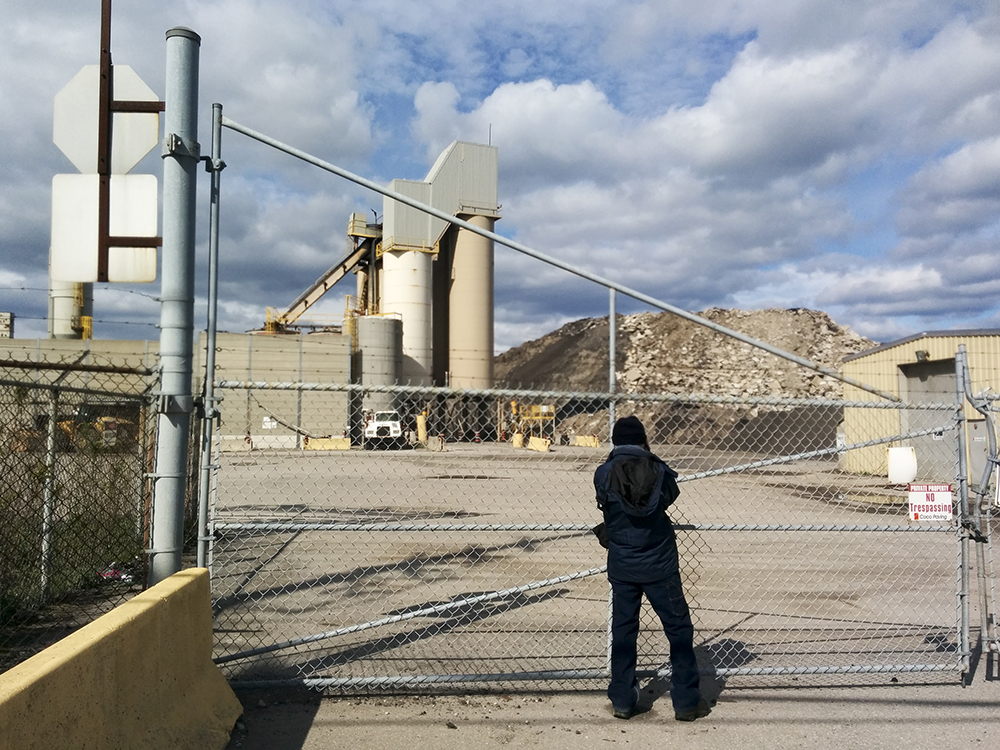
We saw a mountain of asphalt awaiting recycling from both Mavis Road as we walked south, and Wolfedale Road, as we walked north. It’s hard to get a sense of the scale here, but there were roads leading up the pile for trucks to dump their load.

IMG_20160515_165300editsmall

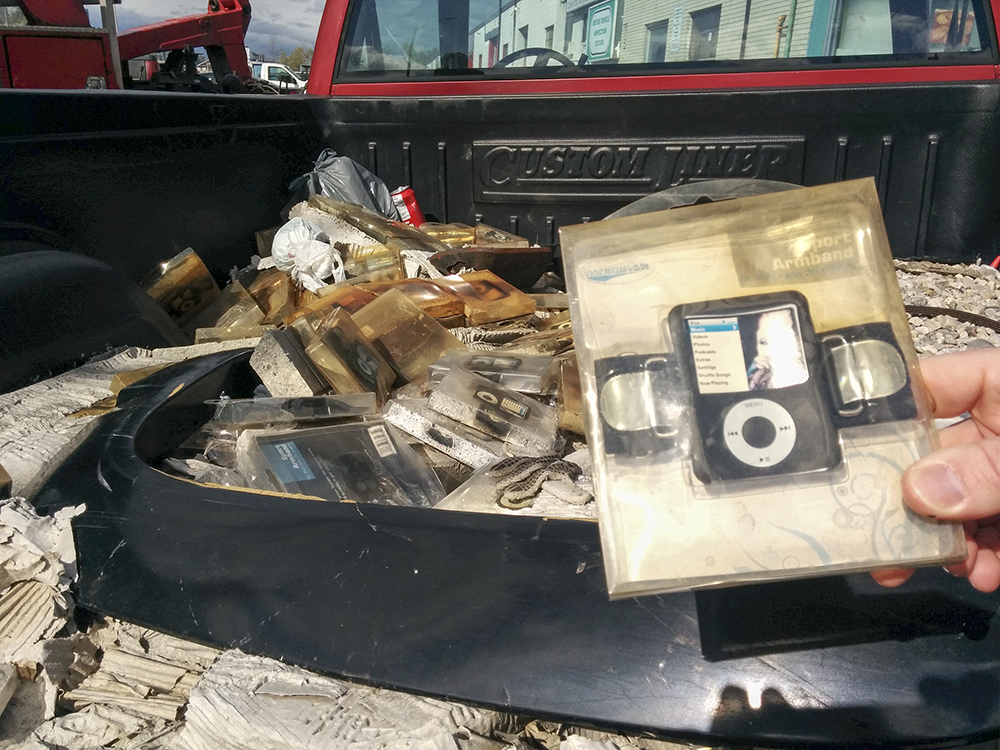
A battered truck parked in a corner parking lot was full of iPod Nano arm bands, wet and rusting.

IMG_20160515_165757editsmall


As we approached the end of the walk, again, we could see Mississauga’s towers rising in the background behind this industrial wasteland.

IMG_20160515_170225editsmall

I have driven these roads before, but never walked the sidewalks.  It wasn’t a place I ever thought to walk and probably won’t walk again.  However, the company and the information shared, made for a pleasant afternoon in the Dross Land.


Dross Walk Delayed

I started my day with breakfast in bed served by Owen, aged 11. About 11am I headed out for a 35km cycle, the last 15km of which were in the rain and wind which began shortly after I left Starbucks having refreshed myself with a cappuccino and a chocolate chip cookie.

When I got home the last thing I wanted to do was go for a walk in the rain, but the forecast promised clearing so I had a quick, warming shower and we headed out enticed by Stephen Caulfield‘s humourous description for the Jane’s Walk entitled The Dross Walk that he is leading.  We drove down the 410 to Mississauga under gray skies entirely appropriate for the subject walk.

“Okay, enough with the suburban revisionism and the relentless positivity. Time to walk the dross. People, we’re gonna get you in touch with rage and depression, boredom and awe as we pass extractive industries, a species graveyard and a wingless aeroplane… Bring Tylenol. Get a tetanus shot.”

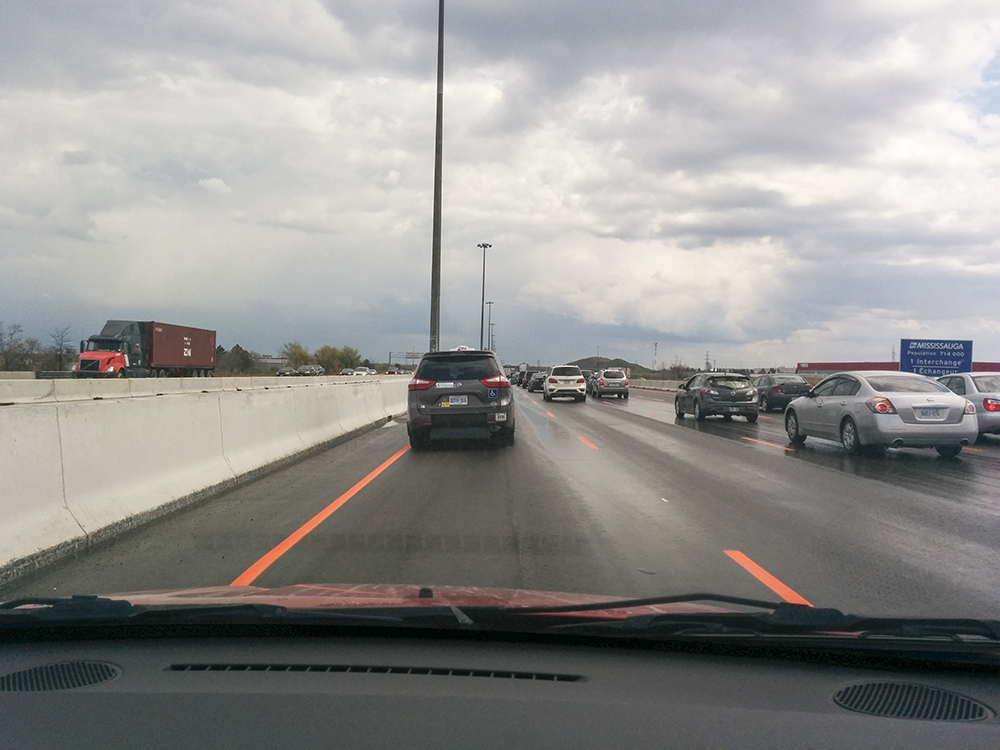
As we crossed into Mississauga, Highway 410 slowed to a crawl.  The concrete barriers had been moved closer to the centre to reveal and a new lane, and, apparently the change was enough to slow traffic.  Either that or induced demand is already at work.

IMG_20160508_143518editsmall

I snapped a picture (from the passenger seat) and tweeted that we were on a new bit of Hwy 410 on our way to The Dross Walk. A few minutes later a Twitter contact pointed out that the walk is next Sunday, not today.  Oops.

So we decided create our own personal Jane’s Walk starting with a walk around Kariya Gardens, south of Square One, since we were there and no longer had anything to do. Unfortunately, the cherry trees are not out yet and the garden was rather barren.  Just north of the garden was an area long vacant with dross-like qualities.

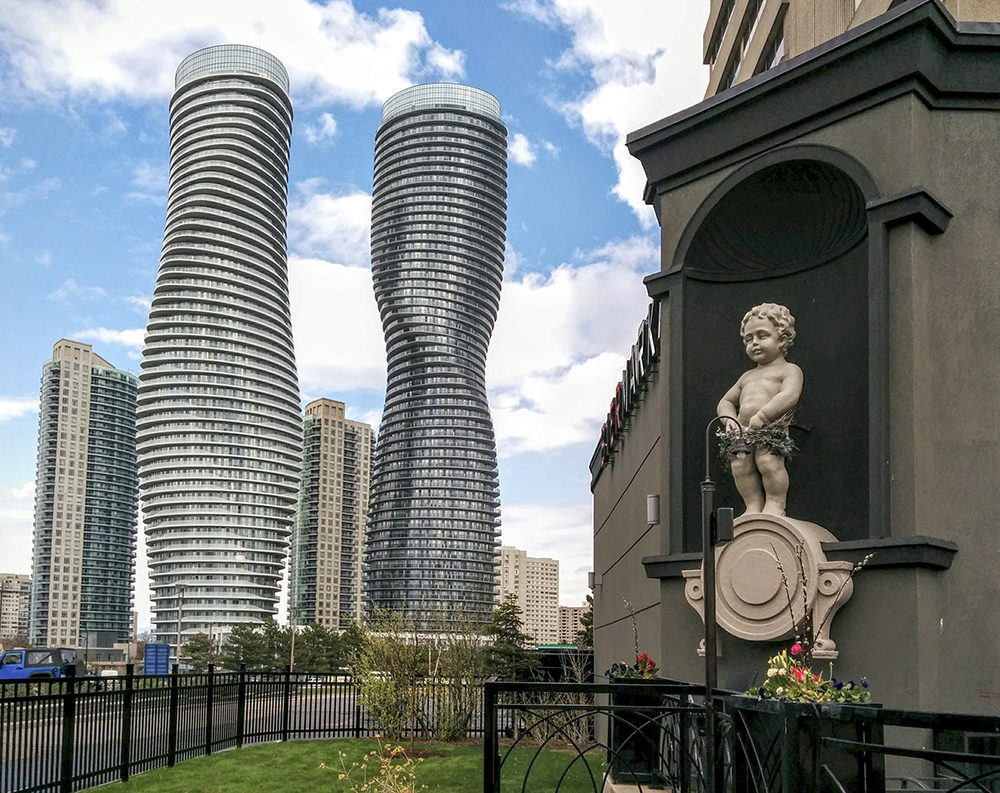
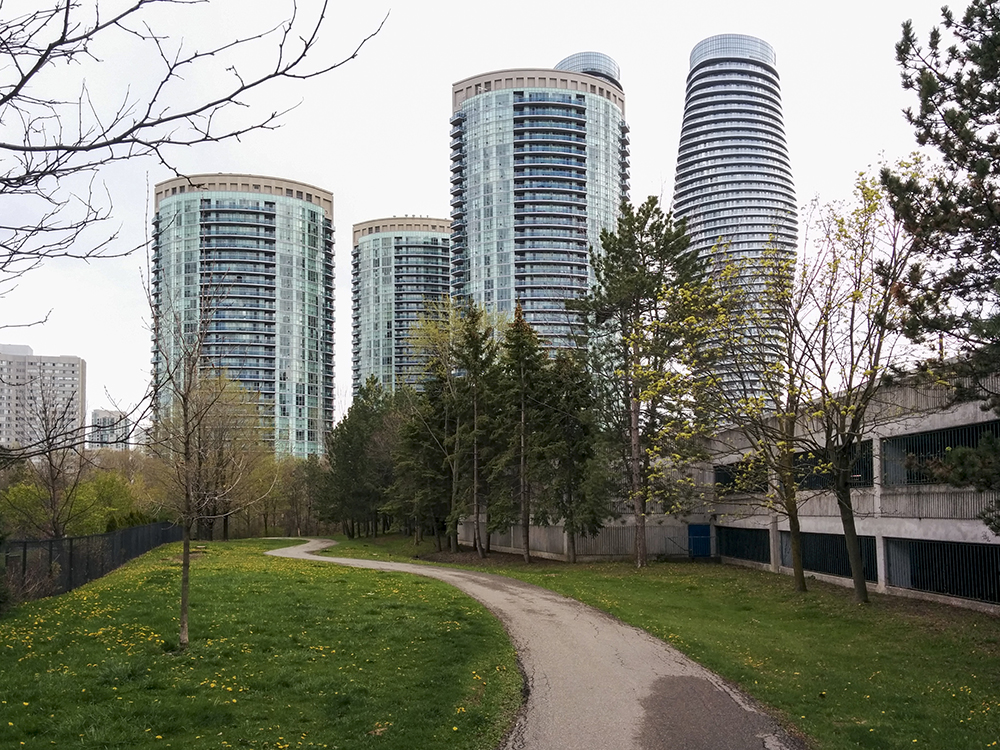
We parked on the top of a multi-storey lot at Square One where the weather continued to threaten wet and windy conditions.  Down the stairs, across City Centre Drive and this great view of Absolute Towers juxtaposed interestingly with the Mississauga Manneken Pis.

IMG_20160508_153213editsmall

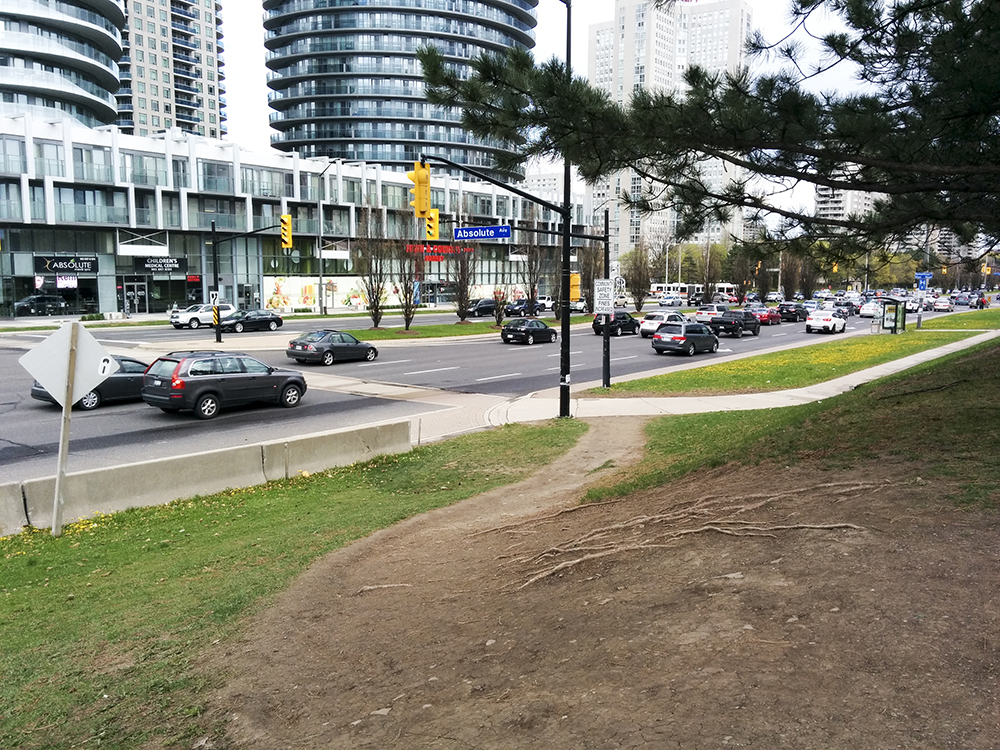
We headed down this desire line, the most efficient way to a light-controlled intersection where we could cross to the Absolute Towers.

IMG_20160508_153437editsmall

I can never get enough of these towers.  I always admire them from near and afar.

After exploring the little grocery store at the base of the towers we headed east towards a fabulous piece of active transportation infrastructure, over Cookville Creek, on the Burnhamthorpe Trail. Before this bridge was installed the trail was interupted where the road bridge was too narrow to carry it across along with the traffic lanes and a skimpy sidewalk.  Well done Mississauga.

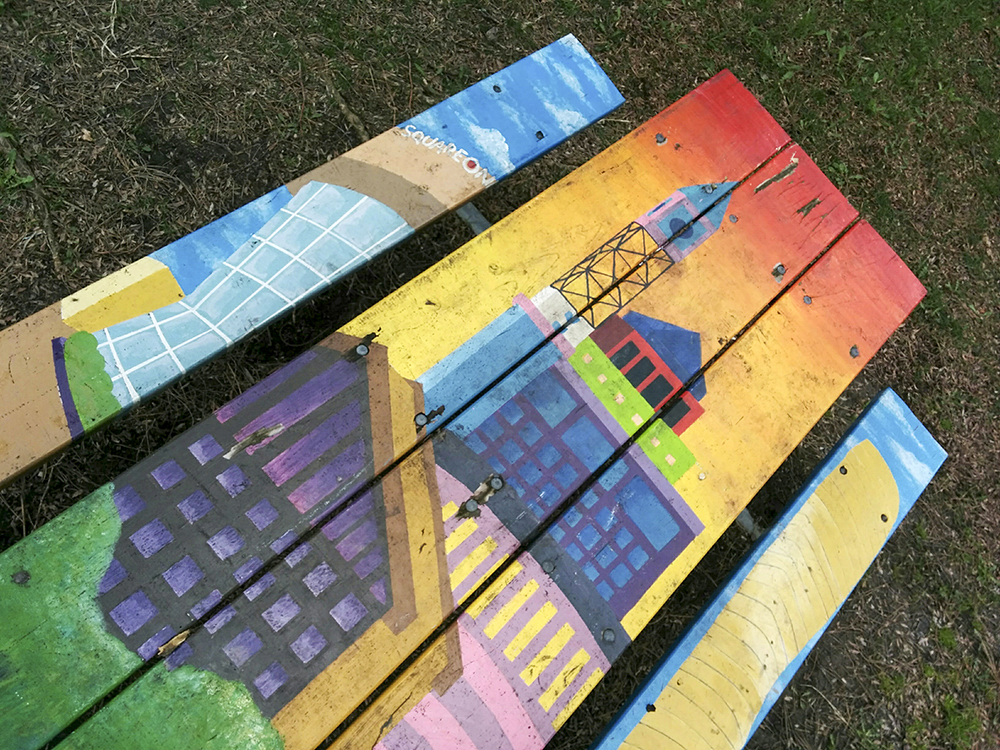
We turned onto Robert Speck Parkway and discovered this great picnic table at the entrance to a park that led to Cooksville Creek.

IMG_20160508_155744editsmall

Even though this area is getting very built up there is some nice green space. We followed the path along the edge of a parking garage on one side and some low rise office buildings on the other.

IMG_20160508_155821editsmall

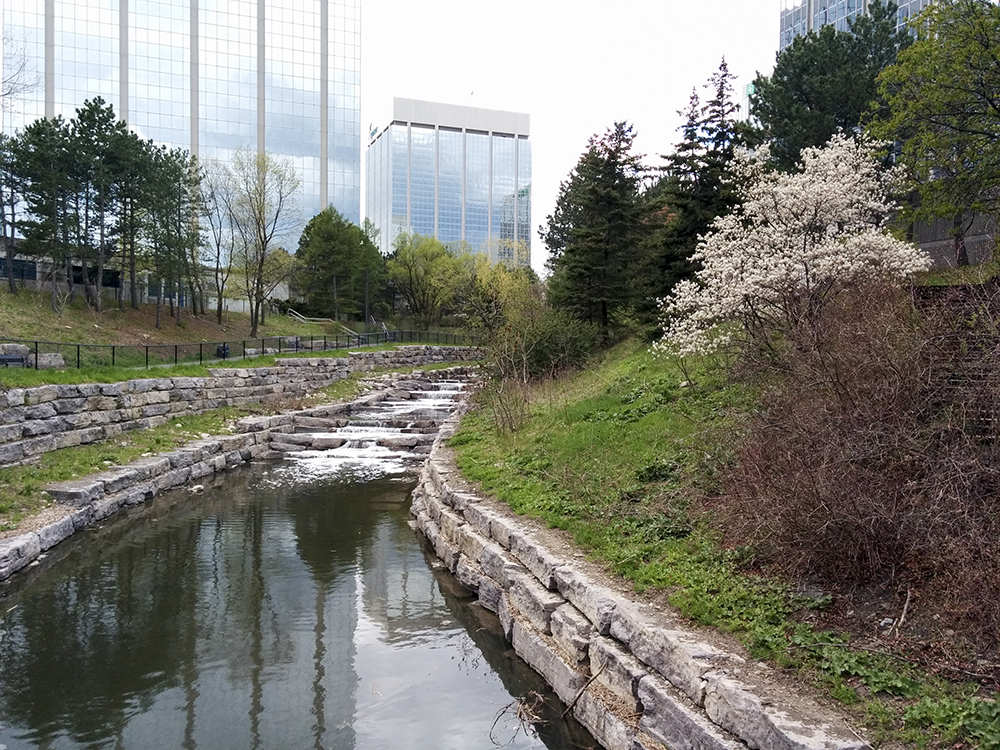
As we approached the turn in the path we could hear water and came upon this great view.

IMG_20160508_160109editsmall

The glass office buildings almost disappeared into the sky, reflecting the conditions around them and made an interesting backdrop to the water and vegetation. I do wish the fence was not placed along the edge of the path.  One can go around the fence at the beginning or end of the path, so it seems rather pointless and creates a visual barrier.

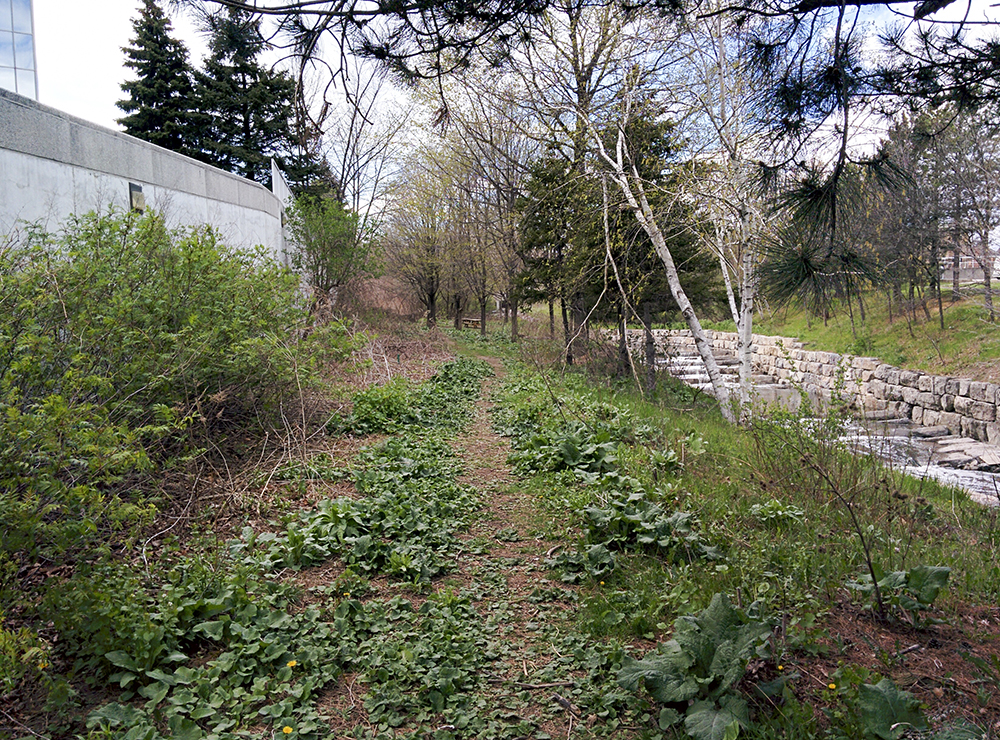
Some attempt was made to create a pleasing space under the Robert Speck Parkway bridge crossing the creek.

At the end of the path, where one is expected to climb up to Robert Speck Parkway, we found another desire line leading to a couple picnic tables where we sat for awhile.

IMG_20160508_161141editsmall

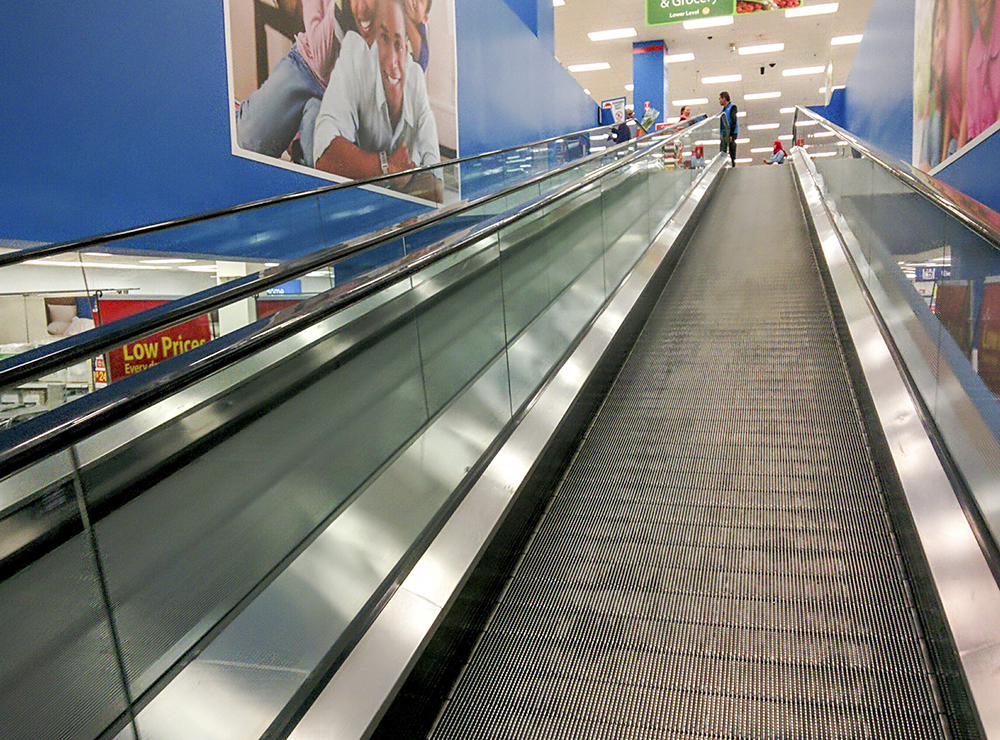
We ended our walk inside Walmart and took a trip up the “rampolator”, the only one I can recall ever encountering, left over from when Woolco was in the space.

IMG_20160508_163623editsmall

I arrive home to a lovely bouquet of flowers from Trystan for Mother’s Day. Megan and Alun gave me Cadbury Dairy Milk chocolate bars and a huge bag of M&M Peanuts.  I will need to do a lot more walking and cycling to work them off.

IMG_20160508_171435editsmall


Dixie Road Cycling Facilities North of Bovaird Drive


This is the first of three blog posts I will make about cycling in, or near, the Dixie Road corridor, and the various cycling facilities, or lack thereof.

  1. Dixie Road Cycling Facilities North of Bovaird Drive
  2. Bramalea GO Station to Clark Boulevard (Bramalea City Centre) along Dixie Road
  3. Clark Boulevard to Bovaird (Chinguacousy Trail)

Last Fall I took a ride along the Chinguacousy trail  from south of Bovaird to Countryside Drive and took pictures.

Overall, north of Peter Robertson, it is a trail with good bones that, with some tweaks, could be an excellent trail for recreation or commuting.

IMG_1679&80 editsmall

The Chinguacousy Trail comes from the south to the southeast corner and continues diagonally opposite on the northwest corner.  There is no signage on the southeast to indicate how one should continue. This is a simple fix and the city has some signage on McVean at Ebenezer, where the trail crosses to the opposite side of the road, which could be used here.

One could also choose to travel east or west along the Bovaird Trail, on the south  side of Bovaird, rather than continuing north parallel to Dixie Road. The Dixie and Bovaird intersection was recently reconstructed for the new Zum route on Bovaird and the Chinguacousy Trail connects to the eastbound Bovaird Trail with a ribbon of asphalt inside the sidewalk to keep pedestrians and cyclists separate. Initially there was only the narrow sidewalk, but I pointed out that it was a poor design for a potentially busy spot and an opportunity to connect two major trails.  The Region listened and added the asphalt ribbon.

IMG_20160421_134240editsmall

They also relocated a badly placed fire hydrant.


Ching Trail vs Dixie Road

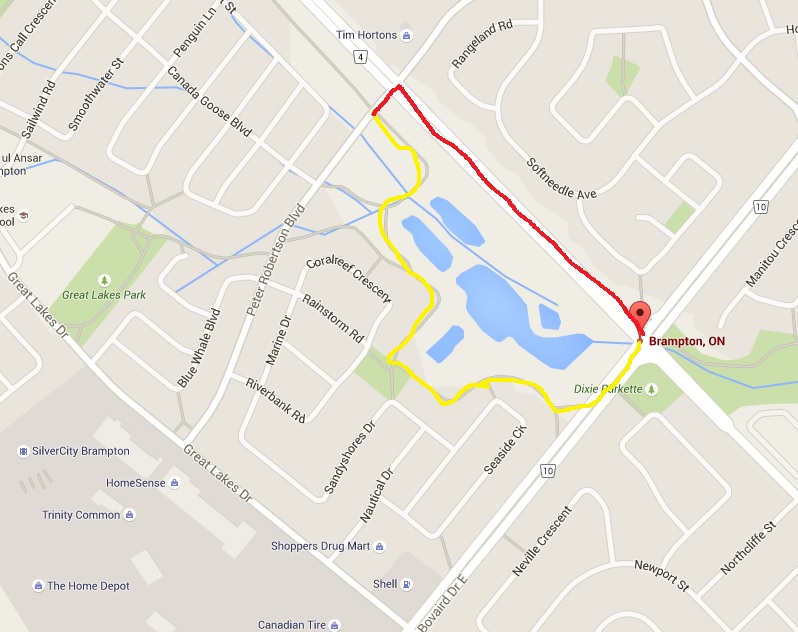
 The reason I specify that the trail has good bones from Peter Robertson, but not between Bovaird and Peter Robertson is because it is so indirect between those two streets.  There is construction for a short way north of Bovaird due to the intersection improvements and as far as I can tell, there is no intention to have a multi-use path adjacent to the road, which means that instead of traveling along the red line for 600 metres, a cyclist would have to travel a hilly route along the yellow line for 1100 metres.
 IMG_1688 editsmall
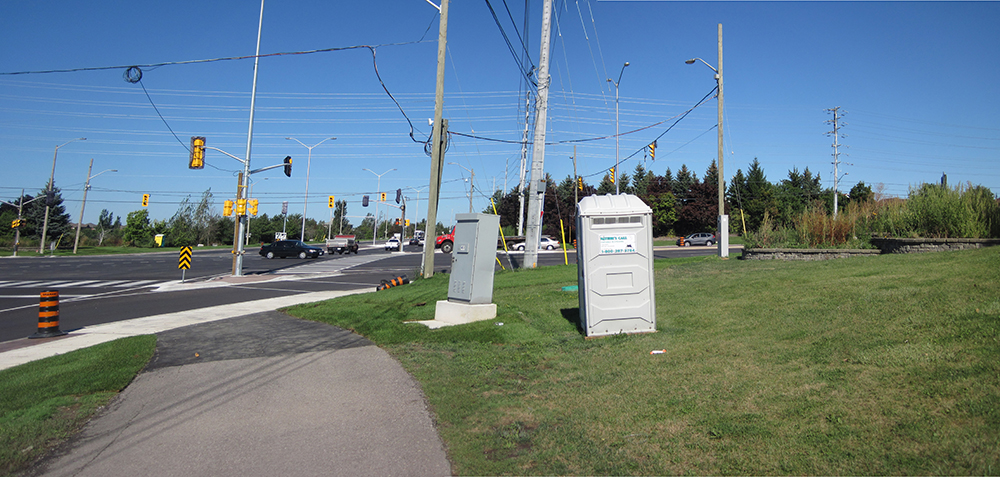
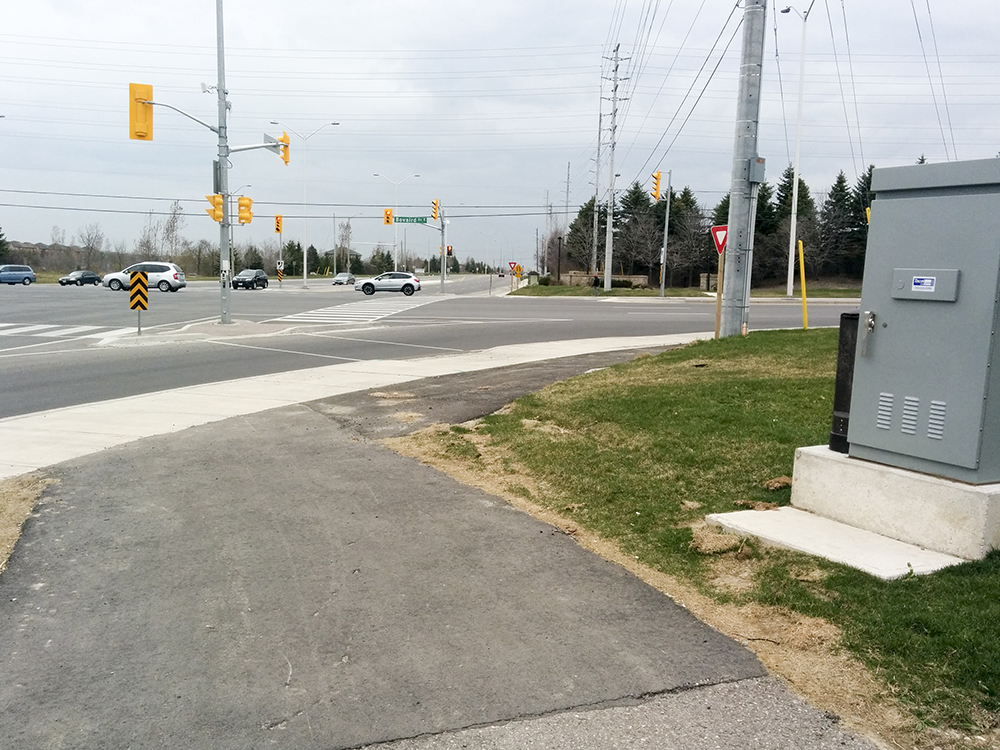
One has to cross both north and west and then travel along sidewalk to the trail that begins just before the bus shelter, then meander through the storm management pond park before emerging at Peter Robertson, where there is a centre median, which means there are four curbs to navigate, or a run down the sidewalk to the light at Dixie, to continue north.
 IMG_1690 editsmall
IMG_1701 editsmallIMG_1702 editsmall
Beginning at Peter Robertson, the path is wide, relatively straight and nicely isolated from Dixie Road with vegetation on both sides.
 IMG_1706 editsmall
At the driveway to the soccer centre, once again there are curbs.
 IMG_1709 editsmall
At Sandalwood the path runs straight into a bus shelter.  Sandalwood also has a centre median meaning four curbs to negotiate or a run down the sidewalk to the light at Dixie.
IMG_1710 editsmall
 The path north of Sandalwood is older, but the asphalt is still in reasonable shape.  The path runs a little closer to Dixie, but is still nicely separated and relatively straight.  As the path approaches Naperton, it is a newer path again and it becomes a more typical in-boulevard trail, rather than being in a narrow park.
 IMG_1713 editsmallIMG_1715 editsmall
The treatment at bus stops is good.
 IMG_1716 editsmall

While the trail is wide and smooth, the intersection treatments concern me.  They always put concrete sidewalks at the corners and generally put a depression leading only onto the ladder crosswalk where it continues to be illegal to cycle.

IMG_1719 editsmall


The trail ends at Countryside, however Dixie has not been reconstructed north of there yet, so I assume the intention would be to continue in the same fashion to Mayfield.

Poor Sign Placement – Castlemore Road

I am relating this story here on my blog as I wish to provide more information to the city insurance claims adjuster but am unable to successfully send image rich emails to the city without them being bounced for being to large.

There is an approximately 2.4 metre multi-use path adjacent to Castlemore Road on the south side running from Airport Road to Highway 50.  This is a continuation of the Bovaird Trail that runs west from Airport Road, with a few breaks, to the Mount Pleasant area. Between the curb and the multi-use path is an approximately 1.0 metre maintenance strip that allows for roadside storage of snow in the winter.  Unfortunately, in most places the maintenance strip and multi-use path are both made of asphalt so that there is no delineation between the two, although occasionally the maintenance strip is made of a coloured, pressed concrete.  To the casual observer, unversed in road construction practices, it appears that there is a single 3.4 metre wide multi-use path.

Between Airport Road and Goreway Drive road traffic signs are placed 1.0 metre in from the curb, ostensibly between the maintenance strip and the multi-use path as in the following images.

The pathway is bidirectional with cyclists generally staying right as is customary in this country.  When eastbound (as in the images) the signs would not pose a problem.  However, when travelling westbound these signs can and do pose a hazard.

In May 2015, at night, my daughter was riding her bike westbound along this section of the pathway.  She was keeping to the right side of the path, approaching Bayridge Drive, when she was startled by an aggressively driven car in the eastbound curb lane, and caught the edge of her handle bar on a sign that was placed in the path, rather than at the edge of the path as is usually the case, and she went down hard on her left side.  She also cracked her phone screen which she was carrying in a cross body bag on her left side.  She was crying and confused when she phoned us for help.  We took her home, cleaned her up and watched her closely for the next few hours.  Fortunately, we determined she did not need a doctor.

Had the sign been placed where the asphalt and grass intersect, as is usually the case, the accident would not have happened.

I wrote to the city and requested that the signs be relocated and that my daughter be reimbursed for her broken phone.  I was informed by their insurance claims adjuster that the signs were placed “no more than 2 metres from the roadway edge” as required by  “provincial guidelines contained in the Ontario Traffic Manual Book” and “it would therefore not be possible as you suggest moving the sign to the outer side of the multi-use pathway as this would place it at too great a distance from the roadway to comply with provincial guidelines”.

The letter continued, “For these reasons we believe that the City of Brampton had maintained this location in a reasonably safe condition and in compliance of provincial regulations.  The City of Brampton can therefore not be held liable in this case.  Although we very much regret your daughter’s unfortunate injury and loss, we must respectfully decline any claims”.

I believe that the adjuster is incorrect because while 5 signs are placed in this fashion between Airport Road and Goreway Road (a distance of 1.4km), a further 27 signs between Goreway Drive and Highway 50 (a distance of 4.9km) are placed exactly where I have suggested they should be placed, between the multi-use path and the grass, significantly more than 2.0 metres from the roadway edge. Furthermore, the signs along the Bovaird section of the pathway, while adjacent to a regional rather than city road, also place the signs more than 2.0 metres from the roadway edge.

According to Ontario Traffic Manual Book 1B, Section 12, “standardization of sign position is important so that drivers can quickly find signs in expected locations”. Thus on a single road all of the signs should be similarly placed in relation to the roadway edge.

Section 12 continues, “Standardization of position, however, cannot always be attained in practice, since signs must be placed in the most advantageous position and must be adapted to the road design and alignment.”  Castlemore Road’s design includes a multiuse pathway which necessitates the signs be placed so as not to obstruct the safe flow of pedestrians and cyclists on the pathway, that is between the pathway and the grass.

Furthermore, whilst maximum horizontal distance from the roadway edge is defined for many types of signs in Book 1B Section 12, there is no maximum horizontal distance from the roadway edge defined for the types of signs posted on Castlemore Road and illustrated in my photographs.

The city cannot have it both ways: the five signs should be moved as I requested.

Since my daughter was travelling from east to west that evening and had safely passed 27  consecutive signs over a distance of 5km that were placed outside of the asphalt maintenance strip and multi-use path, she had a reasonable expectation that the signs over the next 1.4km of pathway would be similarly placed outside of the asphalt maintenance strip and multi-use path .

Here are the other 27 signs.


May 25 UPDATE to this post – I have been informed “these signs were installed in accordance with the applicable city standards and provincial guidelines. However, given the details of this incident, staff will consider relocating the sign(s) in question. ”

I am unsatisfied with this response, however, if the signs are actually moved I will consider it a small victory.


Exploring Hamilton Mountain Staircases

My daughter began attending Mohawk College in the upper city on the mountain in Hamilton in January.  Shortly after she began I discovered that there are several sets of steps from the lower city to the upper city.  As someone who has climbed the CN Tower for the past nine years I was intrigued.  Also, after driving up James, Claremont and Becket accesses and hearing about a cyclist killed on the Claremont access, and knowing that Hamilton is making an effort to be more bicycle friendly, I  was curious as to whether or not there was a safe, and not crazy difficult, way to cycle up the mountain.

I was picking up Megan for the weekend in the mid-afternoon, and had nothing planned for the morning, so I headed out three hours early with my bike in the back of the van with plans to find staircases and climb them, find a bike friendly way to get up the mountain (for a future trip) and explore a new bike path I discovered on Google maps at the east end of the upper city on Mountain Brow Boulevard.

Studying Google maps before I left home I came up with a plan to find the James Staircase to begin, then drive up the Jolly Cut, where I could see on Streetview that there was a narrow painted bike lane and then head to Mountown Brow.

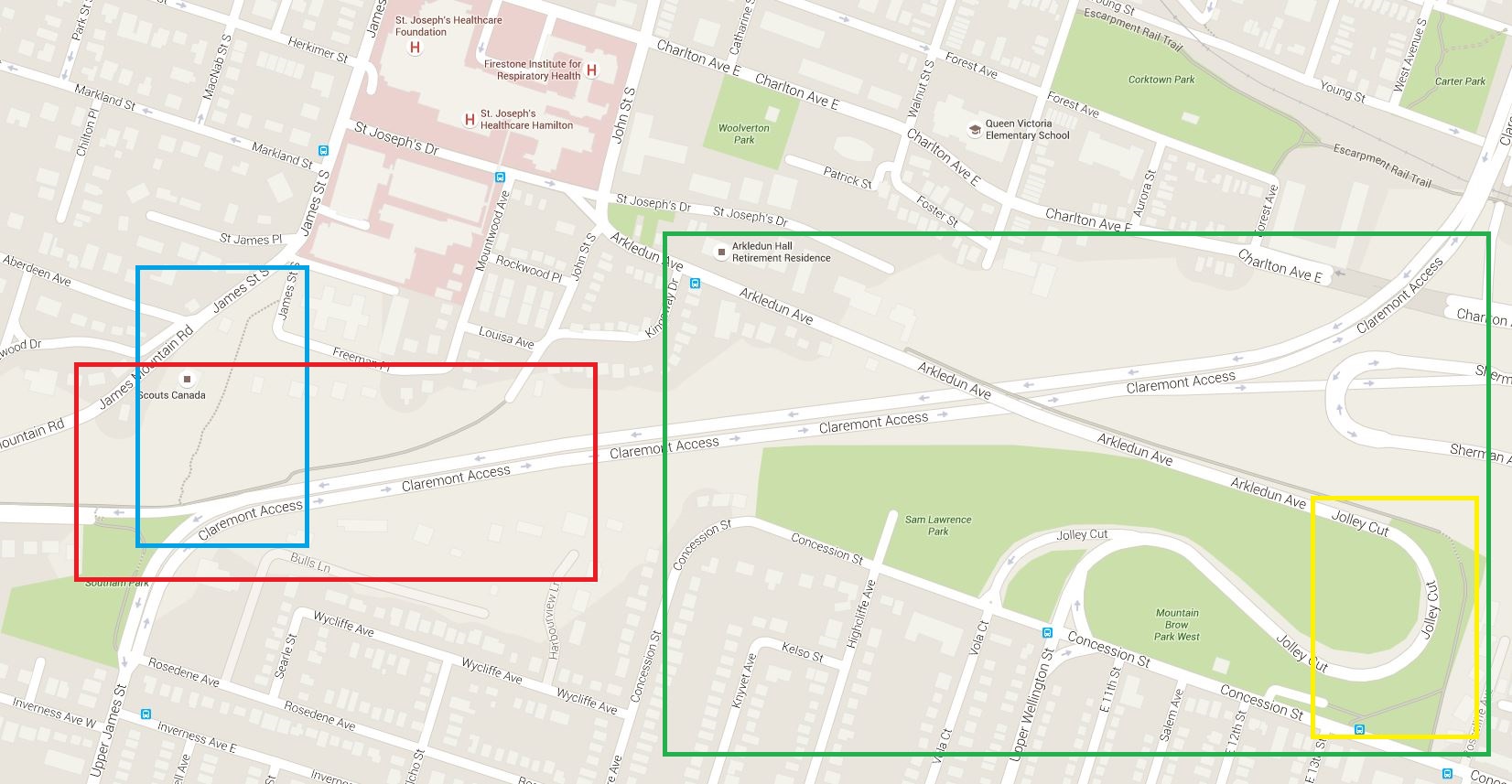
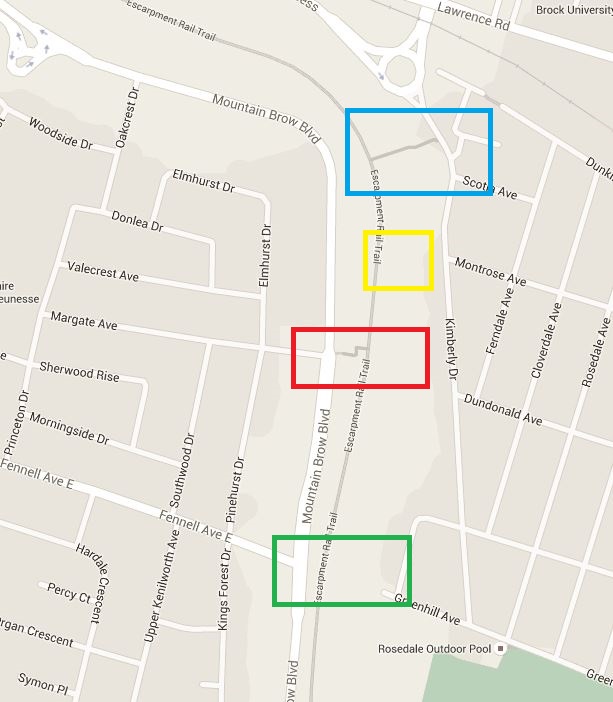
I parked on Freeman Place and walked to the end of John Street South and followed the gray path in the red box on the map below.

Hamilton - Jolly cut - marked


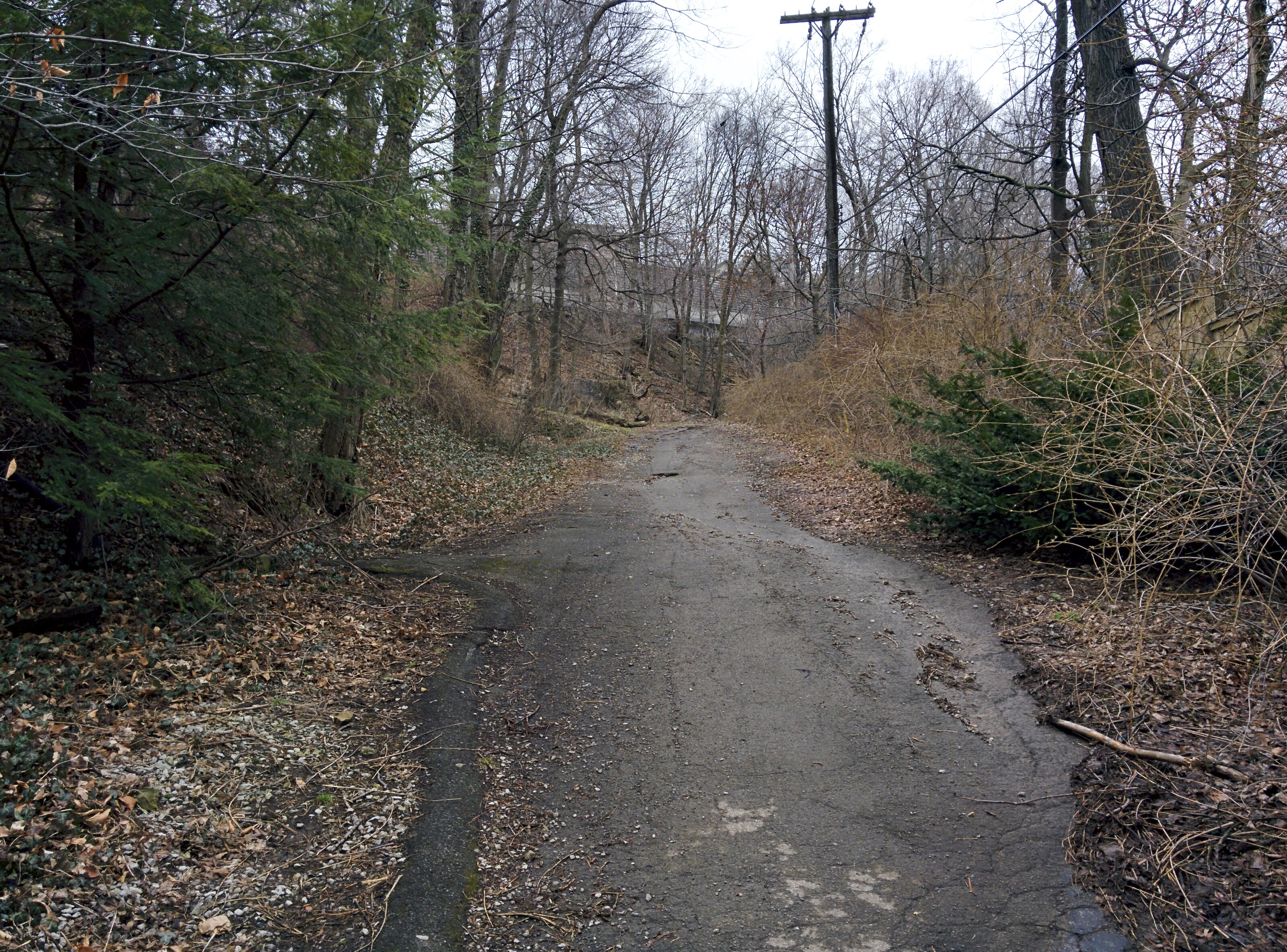
I discovered a wide dirt path through the trees, not the stairs I was expecting.  I decided to follow it anyway.

IMG_20160401_113451 smallIMG_20160401_113705 small

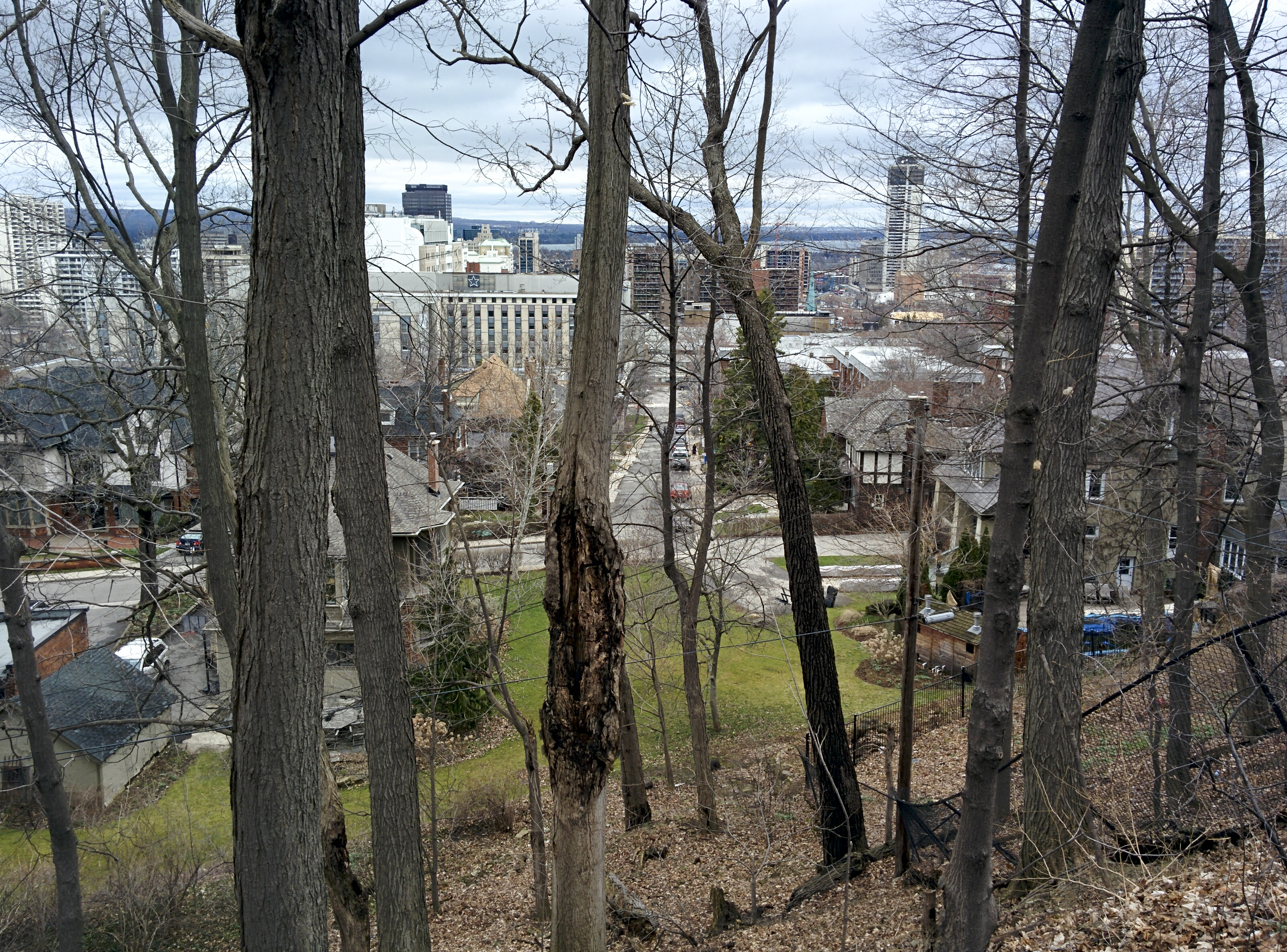
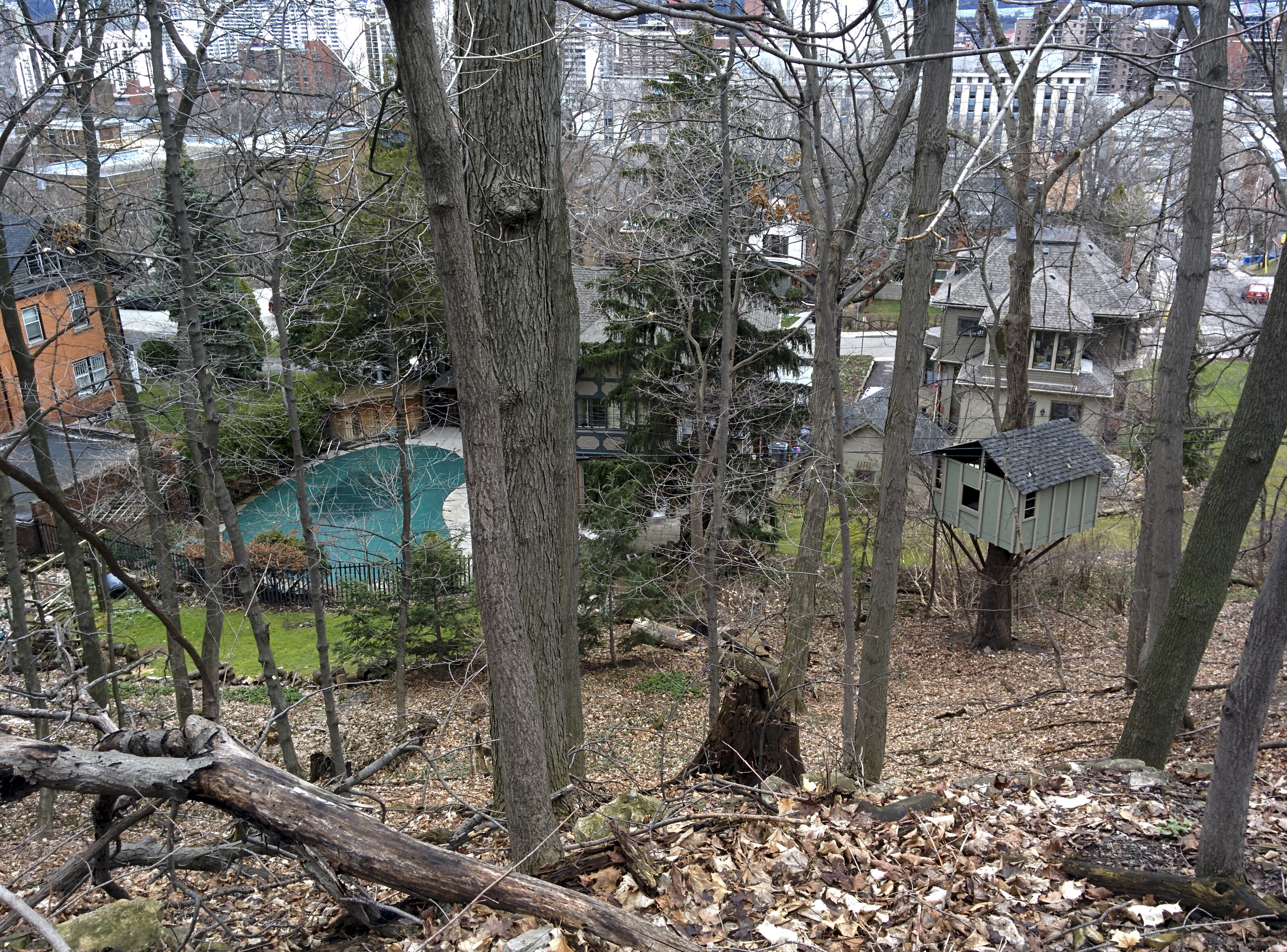
It went up behind some lovely old homes, one of which had a great treehouse in the backyard, with views of downtown and the harbour through the trees.

IMG_20160401_114127 smallIMG_20160401_113724 small

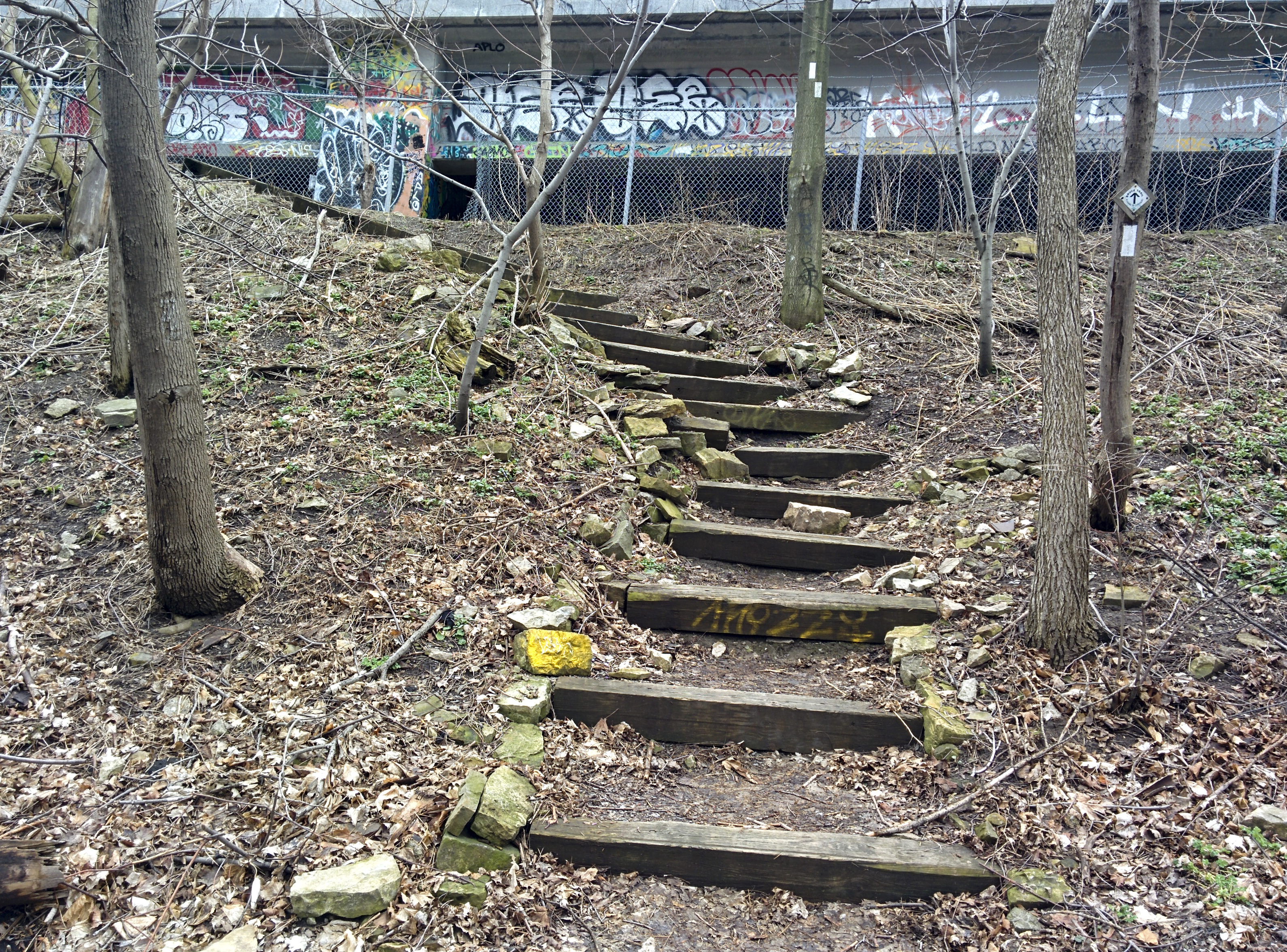
I eventually came to some steps and when I climbed them, found myself at the edge of the Claremont Access and on the Bruce Trail.

I continued to walk along the edge of the Access and eventually came to the sidewalk, which led me to the top of the stairs and Southam Park, after crossing the ramp to West 5th Street.

It was a useful diversion from finding the stairs immediately, as it would be a fairly easy, short route to push a bike up this pathway. I outlined the staircase in blue on the map above.

Interestingly, on a Jane’s walk today, Shawn Micallef said he liked exploring somewhat randomly and then returning home and researching what he had seen on the internet.  Tonight when I was making the map above, I discovered that there is a sidewalk, a small staircase and pathway around the east end of the Jolly Cut that one could follow on foot or if one had a light enough bike to carry on the stairs.  That is outlined in yellow on the map above.  I will have to check that out on my next trip.

After descending the staircase I went back to my van and drove up the Jolly Cut (outlined in green) and over to Mountain Brow.

What a fabulous job Hamilton has done on the bike path along Mountain Brow Boulevard. The path is 4m wide, lighted with solar powered lights and well marked.  There is a small parking lot near the east end of the street between Nova and Ellsworth Drives and several bumpouts for on street parking of about 8-10 cars every so often along the length of the path which is about 2.5km. I got out my bike to explore. This residential road with houses on one side and the escarpment on the other used to be two lanes in each direction.  It is now a much nicer single lane in each direction with the wide bike path along the escarpment making for a much more desirable, and useful for all, streetscape.

Part way down the mountain the is a flat area with a paved rail trail (Hamilton Brantford) which I will definitely be exploring on another day.

The views were terrific even on this overcast day.

In short order I discovered Uli’s stairs (marked in green – above the Rail Trail and yellow, below),  built by hand by a retired local resident in 2005. The city discourages their use and has installed a metal staircase (Kimberly stairs) 300 metres west (marked in red – above the Rail Trail and blue, below).

Mountain Brow map - marked

I cycled the length of the trail and then returned to my car, moved it to one of the bumpouts for on street parking and climbed down the Kimberly Stairs to the rail trail. I walked west to the lower set of Uli’s stairs and then back east to climb the upper set of Uli’s stairs.  I didn’t discover the location of the lower Kimberly stairs until I returned home and studied the map further. I will climb those another day.

Uli’s Stairs:

Kimberly Stairs:

The city has even put in a water fountain at the top of the Kimberly stairs, something rarely seen outside any more. The stairs have bike rails, but there is a ramp access to the rail trail at the east end of  Mountain Brow Boulevard and Mohawk Road East.

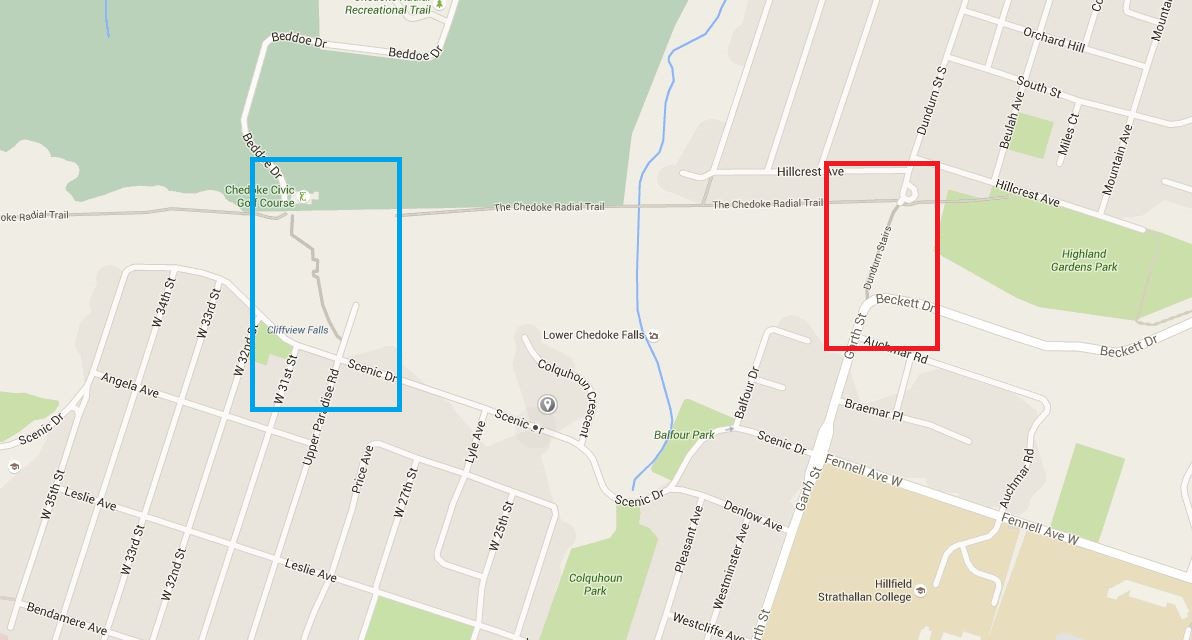
I then returned to my van, drove to McDonald’s for a latte and picked up Megan. Megan then showed me the top of the Dundurn stairs (red box below) which she has recently started using and together we discovered the top of the Chedoke stairs (blue box below), but by this time I was starving so we left those for another day.

Chedoke and Dundurn Stairs - marked

This is the top of the Chedoke stairs, the stairs and the view to McMaster.   These stairs also have a bike rail. The drive to McMaster from Megan’s house near Mohawk on the mountain is 6.7km, but the walk, via the Dundurn stairs is 5.2km.


Brampton Cannot Afford A Tunnel

According to Brampton’s 2016-2018 Capital Budget Overview (on page 69) the City of Brampton has approximately $4.7 billion of assets in operation, excluding land.  As assets are used and age, their useful life declines, which leads to the need for replacement. This decline is known as depreciation expense and is considered to be the minimum amount of funding that should be set aside each year to ensure that the assets can be repaired  and/or replaced in the future.

Any gap between depreciation and the amount set aside for repair and replacement is called the annual infrastructure gap.  Additionally, there is an accumulated infrastructure gap that is the sum of all the prior annual infrastructure gaps.

Take a look at this chart that was included (on page 56) of the 2015 Budget.

2015 Infrastructure gap


According to the preamble to this chart, on page 55, Brampton has an accumulated infrastructure gap of $1.2 billion, yes, BILLION.

To address this gap, council has passed an infrastructure levy of 2% on property taxes which is represented by the orange on the chart.

Even with this infrastructure levy, they are not beginning to address the accumulated debt, nor are they even eliminating future annual gaps, they are only reducing future annual gaps to the point, in 2024, when they will put aside 93% of that year’s replacement cost. By 2024, they predict they will have added another $322M to the infrastructure debt for a total of $1.5B.

But it gets worse!

Fast forward to the 2016-2018 Budget document with an updated infrastructure gap projection.

2016 Infrastructure gap


The accumulated infrastructure gap is now $1.3B according to the preamble.  Now compare 2024 in the first chart (last column) to 2024 in the second chart (second column from the right), prepared one year later.

They are now projecting that the gap will only close to 79% by 2024 vs the 93% predicted last year.  That is a huge difference.  And now the projected annual additions to the infrastructure debt over the next 10 years  are $504M vs the $322M predicted last year. If the City was actually closing the infrastructure gap with the 2% levy, with each passing year, the projected annual additions should be falling, not rising.

Clearly something terrible is going on.  How do the predictions change that much in one year?  Perhaps one might argue it is difficult to project out 10 years.  Well, let’s look at the gap predicted for 2016 in the 2015 document versus the 2016 document. 66% versus 53%.  How could they have gotten it so wrong when projecting only one year out?

No wonder squirrels are falling from the roof of the Balmoral Recreation Centre and the pool is closed at Howden.

Yet, despite all the foregoing, six of our councillors thought it was a good idea to turn down a fully funded surface LRT route on Main Street and gamble on the provincial and federal levels of government providing additional funding in the future for a more expensive alternative.

They asked staff to come up with a recommendation for three alternative routes.  Staff have now come back with two alternatives, both options detail a tunnel under Main Street.  The only difference is the number of stops.  The price tag is $570M, not including contingency, for the tunnel piece only, which would begin at Elgin Street.  There would also be the cost from Steeles Avenue to Elgin.

The province has been clear that there will be no funding for any route other than the surface route that was extensively studied and planned, but ultimately rejected.

Brampton cannot afford to build a tunnel given the infrastructure debt we already have; a tunnel that would itself become an asset that would depreciate and have to be maintained in future, adding to the annual infrastructure gap.  On top of that there is the opportunity cost of building an expensive tunnel where a surface route would suffice.

Opportunity Cost is defined as “the loss of potential gain from other alternatives when one alternative is chosen.”

Money spent on a tunnel is money not spent on  repairing all those deteriorating assets we already own.  Money spent on a tunnel is money not spent on assets Brampton lacks that other cities, many much smaller than Brampton, already have.

For $570M we could have:

  • A third hospital (a priority for many who opposed the surface LRT), or
  • A central library (Brampton doesn’t have one and ranks 40/41 when compared to cities across Canada for library infrastructure), or
  • An indoor, year round, Farmers’ Market, or
  • A national level art gallery, or
  • No additional annual infrastructure gap, in other words, fix what we have

Even if, and its a huge if, funding could be secured from the provincial and federal levels of government, there is only so much they will invest in Brampton. If they invest in a tunnel, will they be willing to invest in Riverwalk, which would flood proof downtown Brampton, and allow for future development and protection of our heritage buildings? Will they invest in a hospital, or art gallery?  I think not.

Brampton should not build an LRT tunnel.  The opportunity cost is too high.